
Klipsch Reference Signature Series Gets Its First Demo at CEDIA 2026
Klipsch brought Reference Signature back to CEDIA 2026, and this time the speakers are ready to make sound.
The company first showed the new family as a concept during its invitation-only “Backstage Access” event at CES in January. Eight months later, Klipsch has confirmed six models, explained the new three-way architecture, and opened the doors (at least by invitation) to the first demonstrations in Denver. I’m not there, I’m covering this from New Jersey. Nevertheless…
While this is still a preview, Klipsch says select models will arrive this winter and is targeting $1,600 to $3,000 per pair, but final prices and complete specifications will wait until launch. There are no published sensitivity, impedance, frequency-response, crossover-frequency, or other key specs to examine. Yet.
A Six-Speaker Range for Stereo and Home Theater
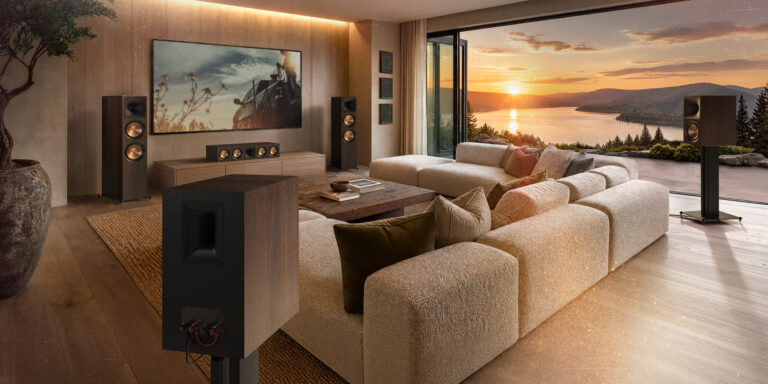
Reference Signature is a complete passive-speaker family rather than a single statement model. The lineup covers two floorstanders, two stand-mount monitors, a center channel, and a multipurpose surround/height module:
- RS-8301F: three-way floorstanding speaker with 8-inch bass drivers
- RS-6301F: three-way floorstanding speaker with 6.5-inch bass drivers
- RS-8301M: three-way monitor with an 8-inch bass driver
- RS-6301M: three-way monitor with a 6.5-inch bass driver
- RS-6301C: three-way center channel with dual 6.5-inch bass drivers
- RS-6101SA: two-way 6.5-inch Dolby Atmos, height, or rear-surround speaker
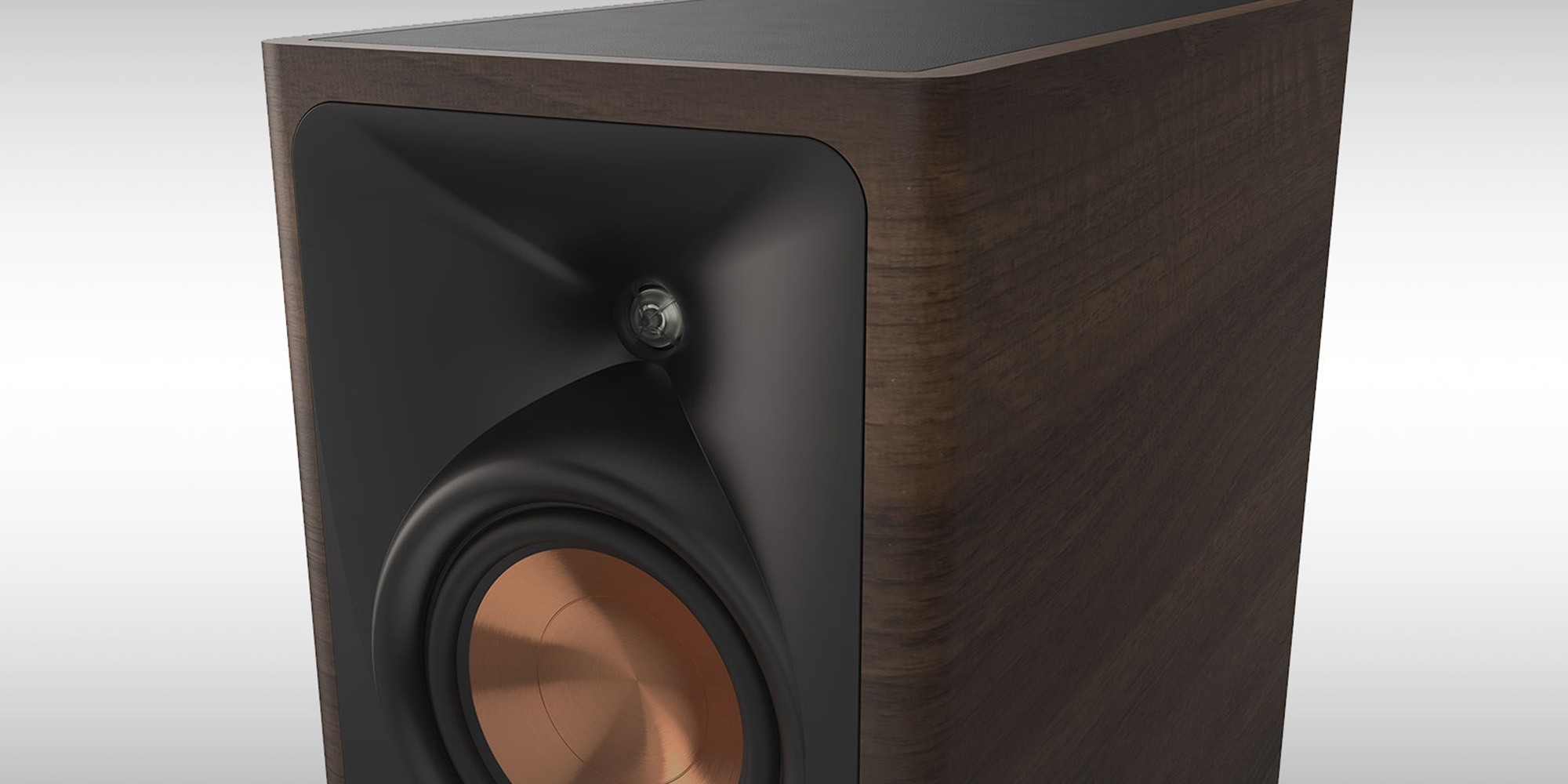
The towers, monitors, and center are true three-way designs. The larger 8-inch models mate their bass drivers to a 6.5-inch midrange, while the 6.5-inch models use a 5.25-inch midrange. Floorstanders and the center get two bass drivers; each monitor gets one. Klipsch’s spun-copper Cerametallic cones provide the familiar visual signature.
The dedicated midrange is the important element.. It lets each driver cover a narrower band and moves the crossover regions away from the range where human hearing is most sensitive. Paul W. Klipsch’s line that “the midrange is where we live” is plenty prescient.
The Horn Is New
Every Reference Signature model uses a titanium-diaphragm Linear Travel Suspension tweeter and Klipsch’s latest horn-loaded architecture. The new phase-aligned design places the midrange directly within the tweeter horn structure so the two sections radiate from the same acoustic center.
The engineering target is better coherence through the crossover and more consistent tonal balance across a wider listening area. That could help a carefully placed stereo pair, but the benefit may be even easier to appreciate in a theater with several seats. Until independent measurements and listening tests arrive, it remains a well-defined design goal rather than a result we can score.
The Center Channel Deserves Attention
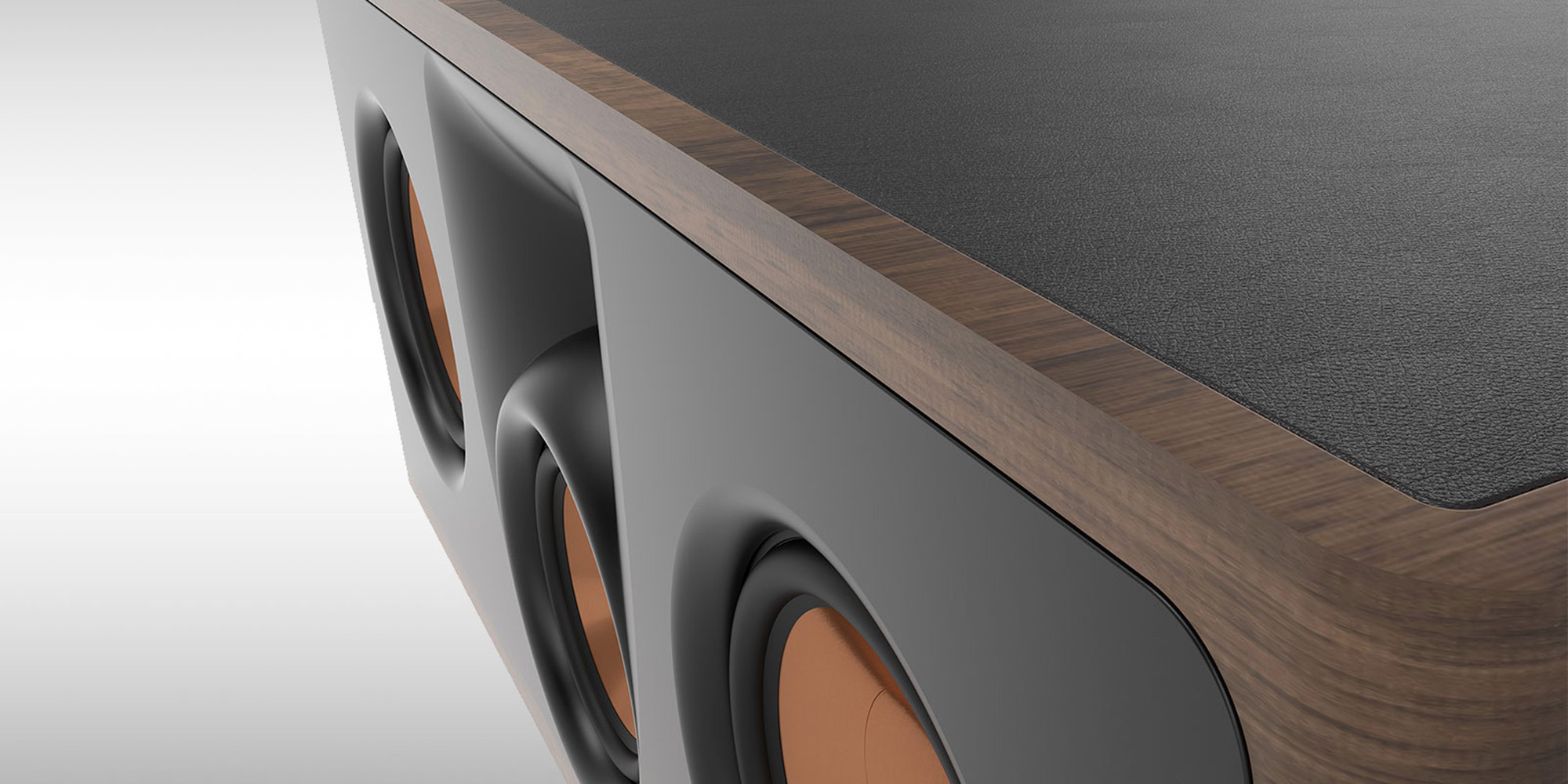
The RS-6301C does not use the conventional horizontal midwoofer-tweeter-midwoofer layout. Its drivers form a vertical array intended to address the horizontal lobing and comb filtering that can make dialogue change in level or tone as a listener moves across the couch.
That choice could be one of the line’s strongest home-theater features. The center handles most movie dialogue and anchors the front soundstage, yet it is often the speaker with the toughest job and the worst placement. A wider, more consistent listening window matters when more than one seat counts.
Built to Look Like a Step Up
Reference Signature keeps the black-and-copper Klipsch identity but moves the cabinetry in a more furniture-like direction. A one-piece BMC front baffle creates a dense, rigid mounting surface, while curved cabinet edges are designed to reduce diffraction and improve off-axis behavior.
Ebony and Walnut finishes carry horizontal grain around the curved, steam-bent-inspired cabinet profile. A leather top panel, metal carpet spikes, and rubber feet add tactile details that separate the range from the more utilitarian side of the Reference family.
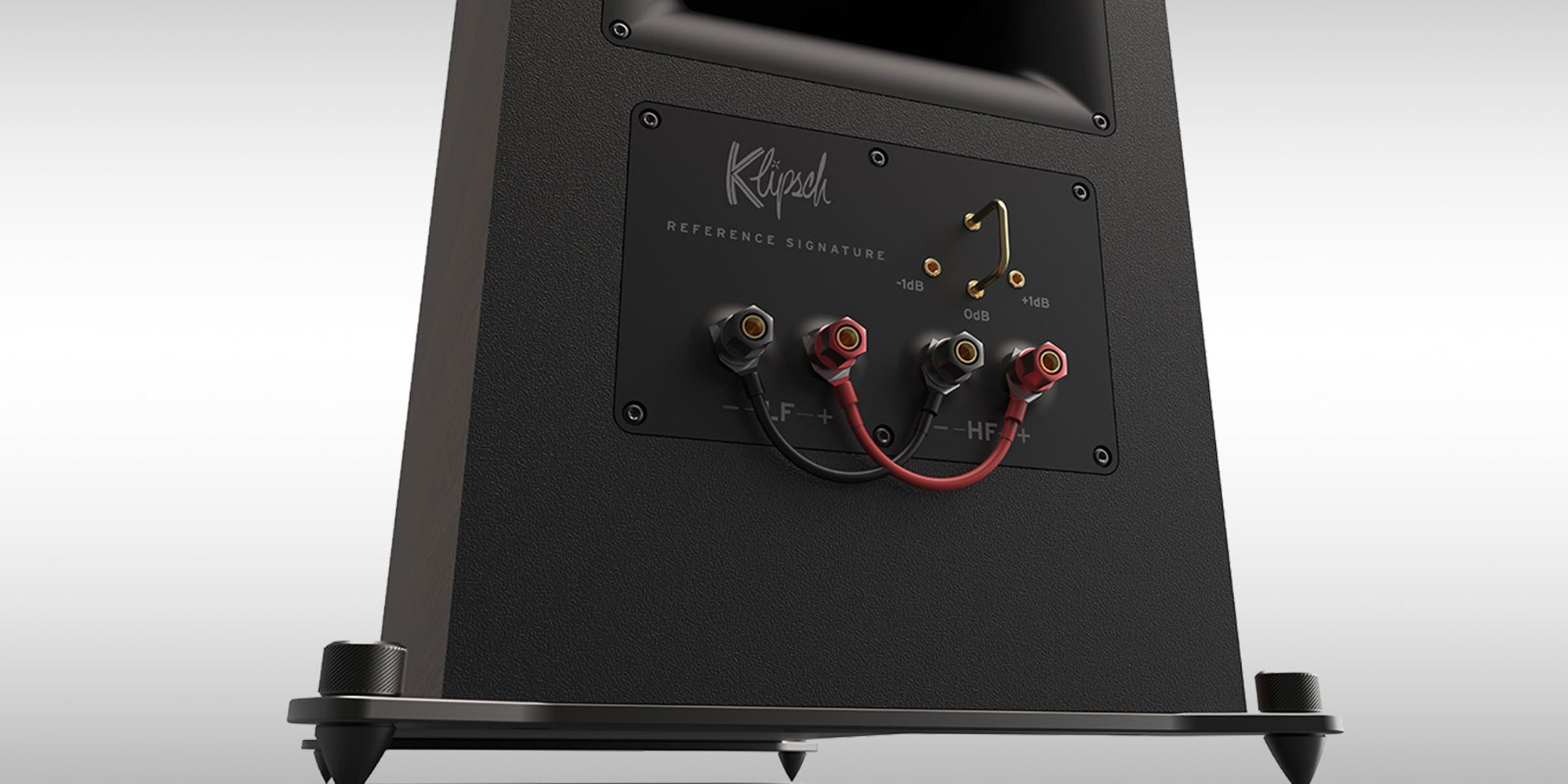
Select models also get dual binding posts for bi-wiring or bi-amping and a simple tweeter-level adjustment: +1 dB, 0 dB, or -1 dB. A one-decibel trim will not replace room correction, but it is a useful fine adjustment for a live room, a heavily damped room, or a listener who wants a small tonal change without adding DSP.
Where Reference Signature Comes From
Klipsch founded its reputation on horn loading in 1946, but the modern Reference story began in 1999. That original Reference Series established the black cabinet, copper-colored drivers, horn-loaded tweeter, high-impact presentation, and broad mix of stereo and home-theater models that became a second visual language for the brand alongside Heritage.
Klipsch reorganized Reference into a tiered strategy in 2014, with the more ambitious Reference Premiere family following as the upper mainstream line. Reference Premiere has moved through several generations, including the second generation introduced in 2022 and the new nine-model Reference Premiere III range announced in August 2026.
Reference Signature is not Reference Premiere III with a different badge. The Premiere models remain two-way designs, while Signature adds dedicated midrange drivers, a different phase-aligned horn assembly, upgraded cabinet construction, and a more premium finish. It is also separate from Project Apollo, the more experimental high-performance concept Klipsch previewed beside it at CES.
Klipsch has not published a formal hierarchy chart. Based on the announced engineering, finishes, and target pricing, Reference Signature appears designed to bridge the gap between Reference Premiere and the company’s costlier Heritage offerings while retaining the system-building flexibility expected from Reference. That is an inference, not an official product-positioning claim.
How the Models Could Be Used
2.0 Stereo
The RS-6301M and RS-8301M are the obvious starting points for a stand-mount stereo system. The smaller model should be easier to place in modest rooms; the 8-inch monitor offers the more ambitious option when scale and output matter. The RS-6301F and RS-8301F eliminate the need for stands and should suit listeners who want deeper extension and greater output from a two-speaker system, although the unpublished specifications prevent firm room-size recommendations.
These are passive speakers, so amplifier matching still matters. Klipsch products are commonly associated with high sensitivity, but it would be premature to assign that trait—or an easy impedance load—to Reference Signature before the final data arrives.
2.1 Stereo
A subwoofer changes the value equation. Pairing either monitor with a well-integrated powered sub can deliver full-range bass while keeping the main speakers and their price manageable. The towers can benefit from a sub too, especially for electronic music, pipe organ, or movie playback where clean low-frequency extension matters more than cabinet size suggests.
Klipsch has not announced a Reference Signature subwoofer. That leaves buyers free to choose based on room volume, output, extension, and integration rather than the logo on the grille. Use bass management when the amplifier or preamp provides it; placement and calibration will matter more than matching the finish.
Surround Sound and Dolby Atmos
The RS-6301C gives the range a timbre-matched front stage, while the RS-6101SA handles the flexible jobs. It can sit on a tower or monitor and fire upward for reflected Dolby Atmos, or mount on a wall as a direct-radiating height or rear-surround speaker. A rear switch changes the crossover between Atmos and Surround modes.
That makes several sensible paths possible. Start with a 5.1 system using towers or monitors up front, the dedicated center, and a pair of RS-6101SA speakers for surrounds. Add a second pair for a 5.1.2 system, or use multiple pairs as surrounds, rears, and heights in a larger immersive layout. The required amplifier channels rise quickly, so budget for the AVR or processor and amplification before counting speaker boxes.
The Budget Question
A target range of $1,600 to $3,000 per pair puts Reference Signature above impulse-buy territory, but “audiophile on a budget” does not have to mean buying the cheapest box. It means spending where the improvement is audible and skipping expense that solves no problem in your room.
For sure. The monitors plus a capable sub may prove to be the sweet spot for many music systems, while the center and flexible RS-6101SA give home-theater buyers a clear reason to stay within the family. The unanswered questions are the ones that determine real value: final per-model prices, measured sensitivity and impedance, bass extension, dispersion, and how the new horn behaves in a normal room.
CEDIA moves Reference Signature from an interesting CES sketch to a coherent product plan. The six models make sense, the engineering changes target real problems, and the cabinet design looks ready for a living room. Now Klipsch needs to publish the numbers.
Sources: Klipsch’s September 2 CEDIA announcement, Klipsch’s CES 2026 concept announcement, Klipsch’s company timeline, and the Reference Premiere III announcement. Product images courtesy of Klipsch.