
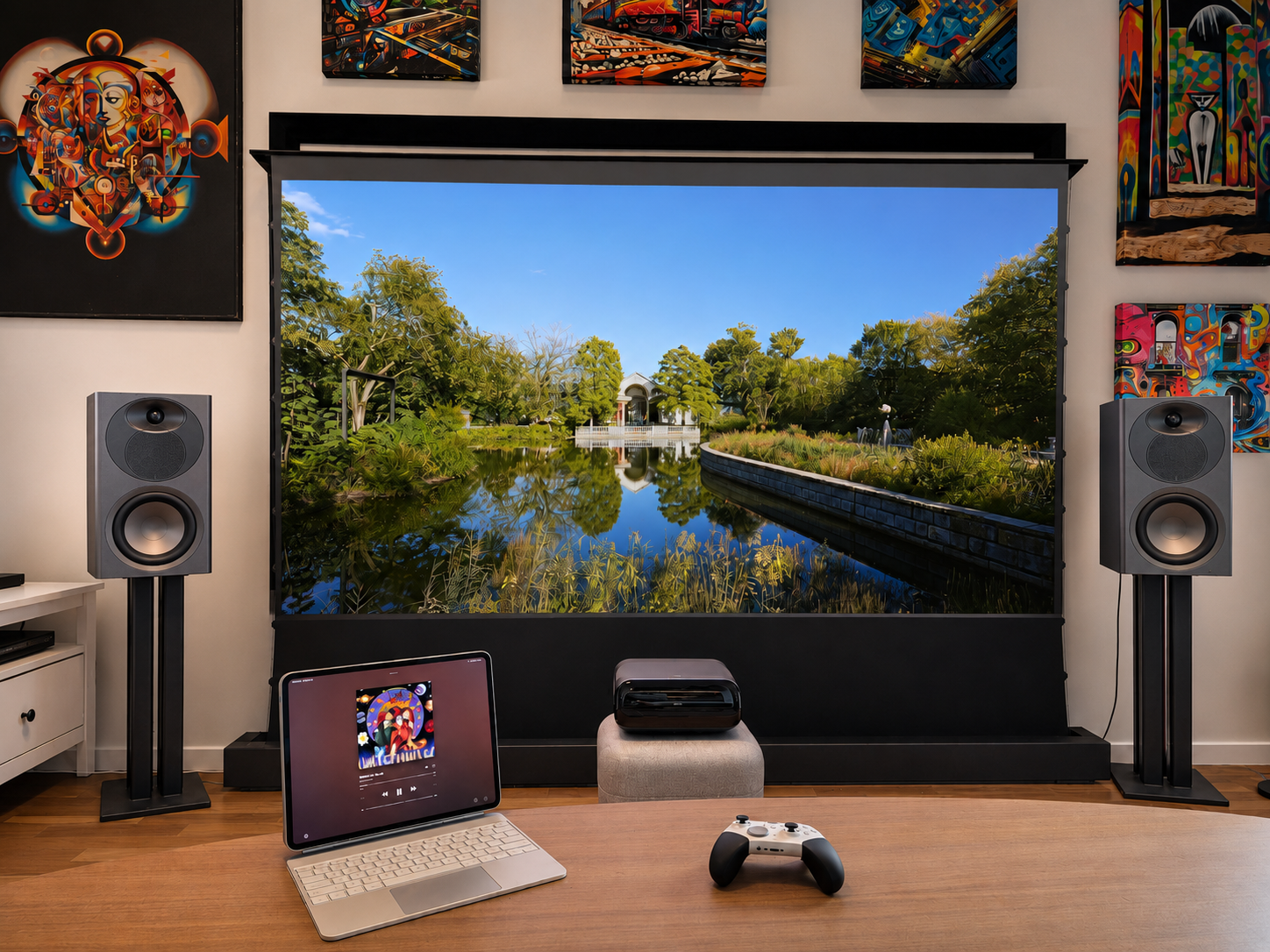
Arendal Sound 1610 Bookshelf 8 Review: The Superpower Is Invisibility

A large Norwegian three-way stand-mount built from familiar ingredients, executed well enough that I stopped missing my subwoofer.
By Mark Henninger | Audiophiles on a Budget
Arendal 1610 Bookshelf 8 | 3-way stand-mount | $3,600/pair | arendalsound.com
$3,600 is a lot for a pair of speakers called Bookshelf 8, especially on a site with “Budget” in its name. There is no point pretending otherwise. But budgeting is not the same thing as buying the cheapest box that makes sound. It is deciding where the money should go, and the 1610 makes its priorities unusually clear: two genuinely capable speakers instead of the same money spread across a pile of compromised boxes.
I have used at least one subwoofer in every personal system since 1991. Then, a few months ago, I bought an Anthem MRX SLM, ran ARC Genesis room correction, and discovered that my subwoofer was mostly taking up space. I was planning a move anyway, so I left it behind.
Since then, I have regressed to pure stereo: 2.0 for music, video games, and movies. I have not forgotten what Dolby Atmos can do; I spent too many years with it for that. But a really good pair of speakers can produce serious immersion on its own, provided you sit near the sweet spot where the soundstage and imaging snap into focus.
The Arendal Sound 1610 Bookshelf 8 is a really good pair of speakers.
This is my first speaker review under my own flag at Audiophiles on a Budget, after years doing this at AVS Forum and Sound & Vision. I still enjoy the work, although the pleasure comes bundled with freight, furniture moving, and the peculiar job of describing something partly measurable and partly subjective while the objectivists and subjectivists lob crockery at one another.
I chose the 1610s because they are interesting in an unflashy way: cones, a dome, a port, a three-way crossover. Nothing revolutionary, you see. Just mature speaker science, disciplined engineering and build quality, and a rational direct-sales model applied unusually well. That made them an obvious place to start.
The Hardware
“Bookshelf” is a stretch. Each 1610 Bookshelf 8 stands 18.8 inches tall, runs 11.8 inches deep, and weighs 35.8 pounds. Plan on proper stands and a little floor space.
The 1610 series arrived in early 2026 to fill the gap between Arendal’s long-running 1723 series and the flagship 1528. The model numbers refer to years in the history of the company’s Norwegian hometown; 1610 is when Arendal earned official trading-port status. The family includes the Tower 8, this Bookshelf 8, a matching Center 8, and the sealed, wall-mountable Slim 8. All share the same voicing, so a stereo pair can grow into a multichannel system without a tonal mismatch. Arendal sells direct and includes a 60-day home audition and a 10-year warranty.
The Bookshelf 8 is a genuine three-way, still uncommon in a stand-mount. A 28mm aluminum-magnesium dome tweeter with a neodymium motor sits in the company’s Røst Essence waveguide. Below it, a 5-inch carbon-cone midrange occupies its own sealed sub-enclosure, while an 8-inch high-excursion aluminum-cone woofer handles the bottom end. The crossover points are 330Hz and 2.3kHz.
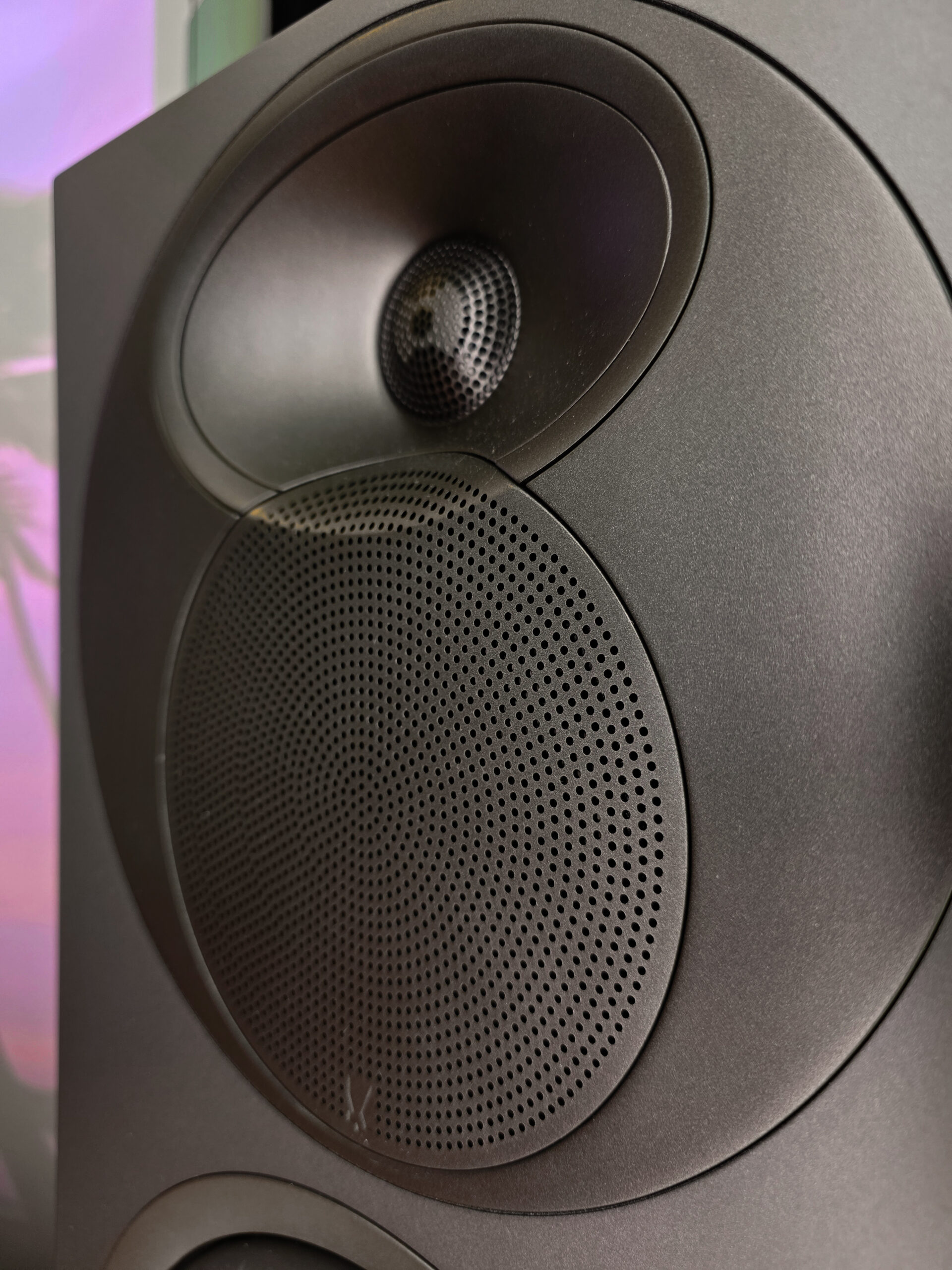
The most conspicuous piece of engineering is the 46mm-thick curved front baffle, built from bonded layers of HDF and shaped to align the acoustic centers of the three drivers. Arendal says the geometry improves phase and transient response. I did not measure time-domain behavior directly, so I will not promote that to a lab finding. What I heard was consistent with the design intent, however, and I will come back to that.
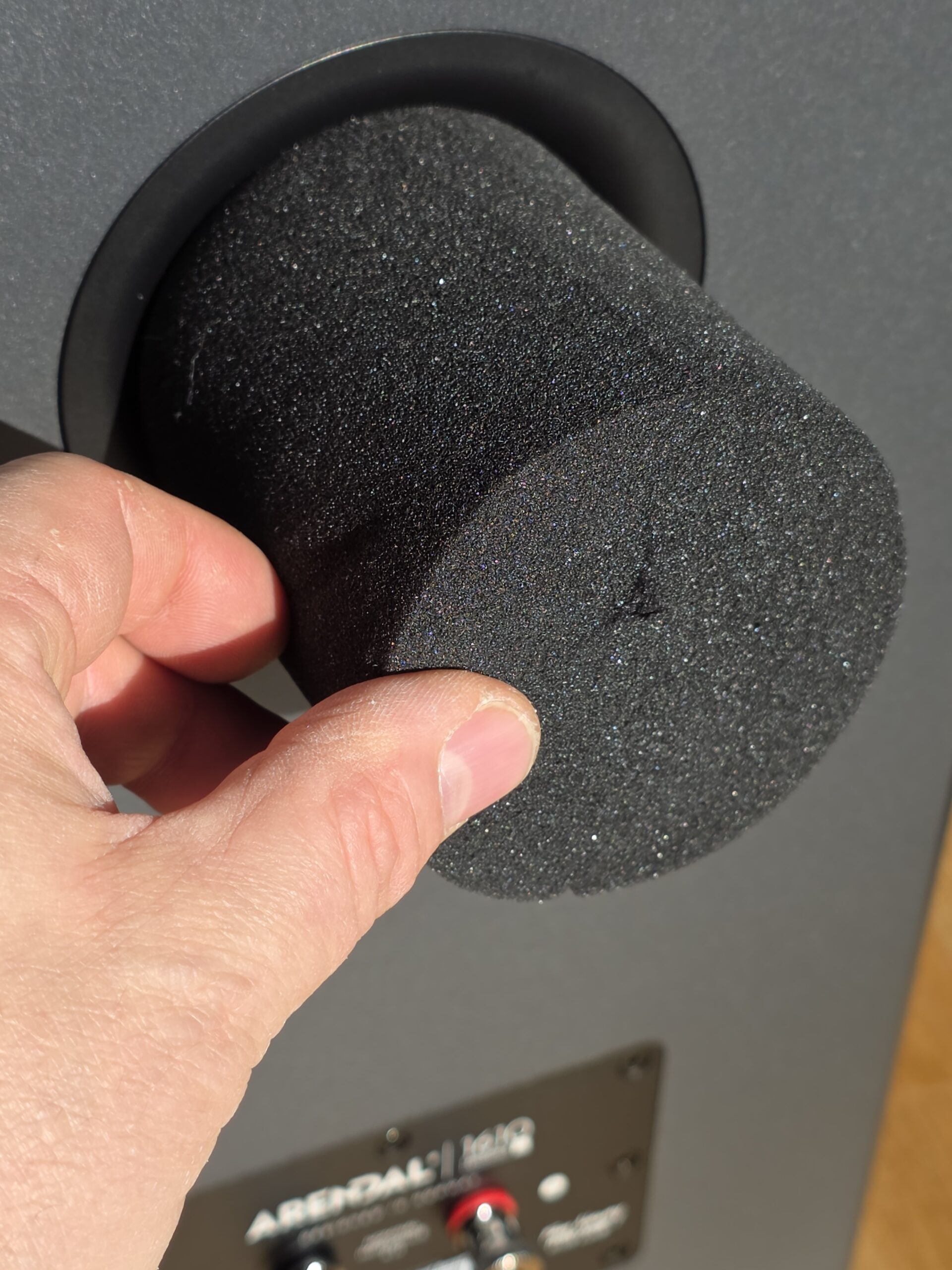
The rest of the cabinet is HDF with extensive internal cross-bracing. Finish options are Basalt, a satin dark gray with subtle metallic particles, and Polar, a white satin. The rear-vented cabinet comes with port plugs that convert it to a sealed alignment. Vented, the rated -6dB point is 34Hz; sealed, it is 44Hz. Sensitivity is a modest 85dB (2.83V/1m) into a nominal 4-ohm load, so use an amplifier comfortable driving 4-ohm speakers.
Build quality and fit-and-finish are exemplary. Even the packaging earned my respect: it is extremely protective but designed so getting a 36-pound speaker out of its carton, and back into it, does not become a wrestling match. Reviewers notice these things. So will you, the day you move.
Specs at a Glance
| Design | 3-way, rear-vented with included port plugs for sealed operation |
|---|---|
| Drivers | 28mm aluminum-magnesium dome tweeter with Røst Essence waveguide; 5-inch carbon-cone midrange in sealed sub-enclosure; 8-inch aluminum-cone woofer |
| Crossover | 330Hz / 2,300Hz |
| Frequency response (-6dB) | 34Hz–20kHz vented; 44Hz–20kHz sealed |
| Linearity | 47Hz–20kHz (±2.5dB) |
| Sensitivity | 85dB (2.83V/1m) |
| Impedance | 4 ohms nominal |
| Dimensions | 18.8 inches H × 10.5 inches W × 11.8 inches D |
| Weight | 35.8 pounds each |
| Price | $3,600/pair |
My Setup
Six inches. That is all the breathing room these speakers got from the wall behind them, which is life in a compact urban apartment. My listening space is roughly 13 by 20 feet with 9-foot ceilings, a rug, a sofa, and the usual living-room clutter. There are no dedicated acoustic treatments.
The tweeters ended up 100 inches apart with about 20 degrees of toe-in, and the main measurement position was 112 inches from each tweeter. My everyday seat is a bit closer, in the near-to-midfield range. Amplification came from the Anthem MRX SLM in two-channel mode, rated at 50 watts per channel into 8 ohms and 92 watts per channel into 4 ohms with two channels driven. There was no subwoofer.
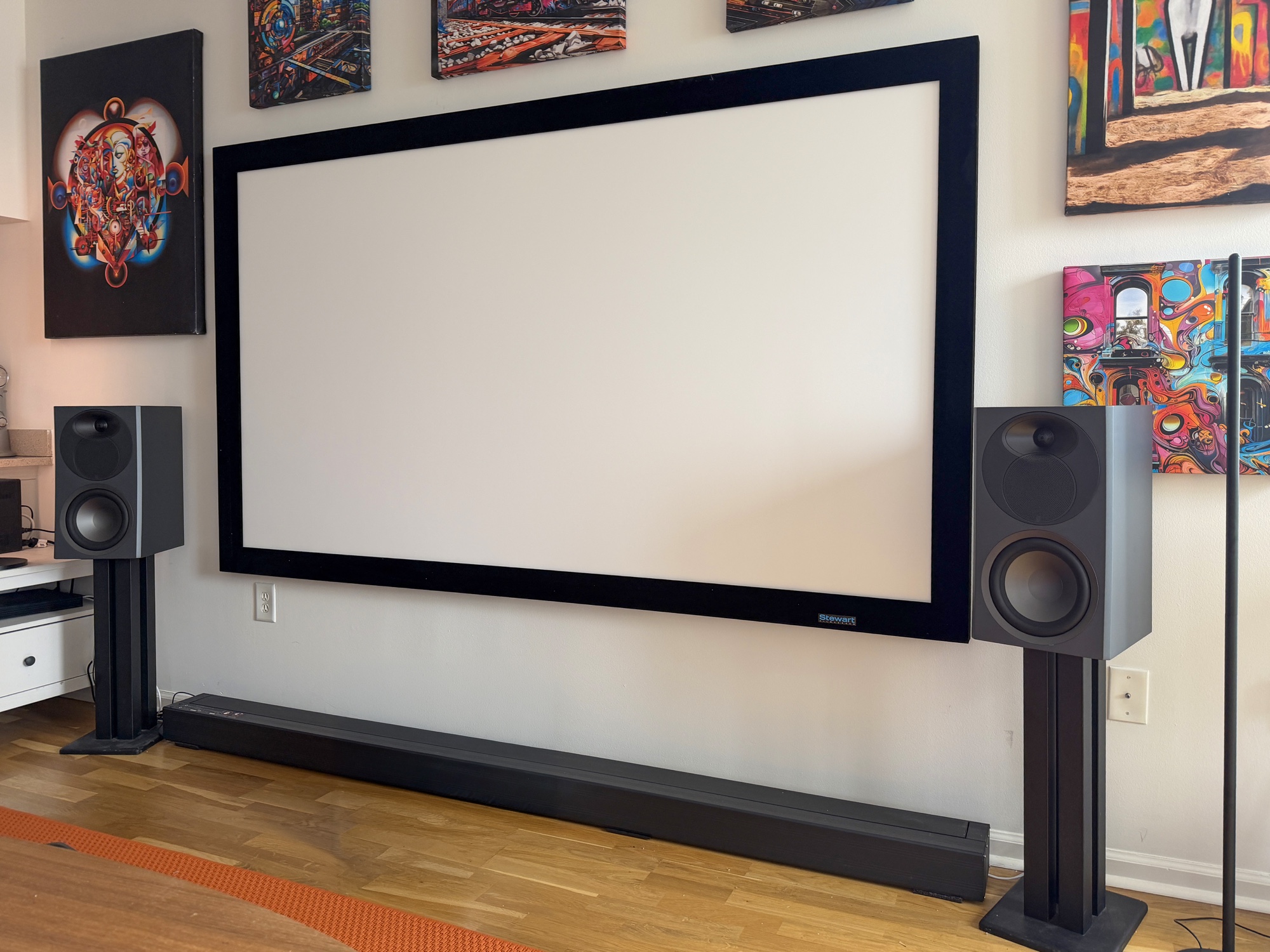
I live in a high-rise, so house-party levels are not in the cards. There are music lovers for whom the visceral, physical component of high SPL is central to the experience. I cannot listen that way here, which is one reason this amount of power suits me. My conclusions about output and composure should be read in that context.
Measurements
I measured every configuration I wanted to compare: ports open and plugged, ARC on and off, each speaker separately and both together. 12 REW sweeps in all. I used a miniDSP UMIK-2 with its 90-degree calibration file at the main seat and cross-checked the results against ARC Genesis. The one-million-sample sine sweeps ran at 24-bit/48kHz. I analyzed the 20Hz-to-20kHz range shown here.
These are single-point, in-room measurements, reflections included. They tell us what happened in this room at this seat. I did not perform anechoic or formal off-axis testing, nor did I measure distortion, compression, or time-domain behavior.
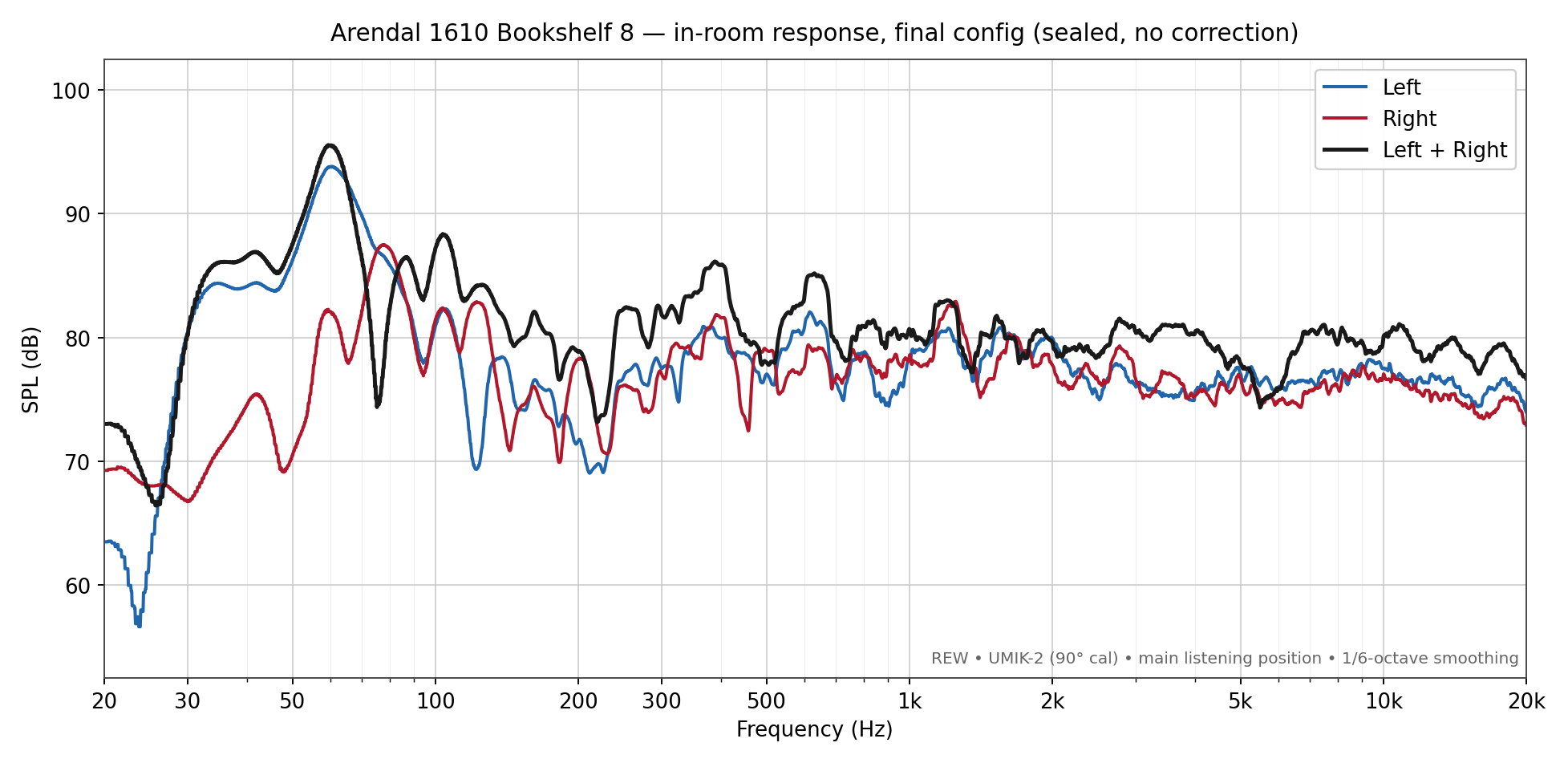
Above 300Hz, the left and right channels match closely, tracking within about a decibel and a half on average through the mids and treble. The largest gaps are narrow interference wiggles in the lower midrange, not broad tonal differences. Treble energy at my seat remains broadly level from the presence region through the top octave. That is consistent with the waveguide doing its job, although one listening-position measurement cannot establish its off-axis behavior.
Below 300Hz, I was measuring the room at least as much as the speaker. Viewed broadly, the 30-to-80Hz band averages about 5.5dB above the midrange, giving the response the bass tilt common to preferred in-room targets. At 30Hz, output is still within roughly a decibel of the midrange before dropping sharply below 28Hz. These are sealed stand-mounts with no subwoofer; room reinforcement at this listening position supplied the last useful half-octave.
The narrower peaks and cancellations are dominated by the room. A large mode centered near 60Hz rises about 15dB above the midrange. That peak is consistent with overlapping room modes: the calculated second axial mode of the 20-foot dimension is about 56Hz, while the 9-foot ceiling’s fundamental is about 62.5Hz. My seat near the center of that 20-foot span could also contribute to the sub-28Hz cliff, since the approximately 28Hz length mode has a pressure null there. This is the most likely room-mode interpretation, but a single-position response cannot prove the causes conclusively. The left speaker couples to the 60Hz mode much more strongly than the right; about +16dB versus +5dB. That is a placement effect—the room, rather than sample variation.
A stubborn notch near 216Hz, 9 to 12dB deep with both channels driven, appeared in every one of the 12 sweeps. It is consistent with boundary-interference cancellation from the speaker and listener geometry, although these measurements do not isolate the responsible boundary.
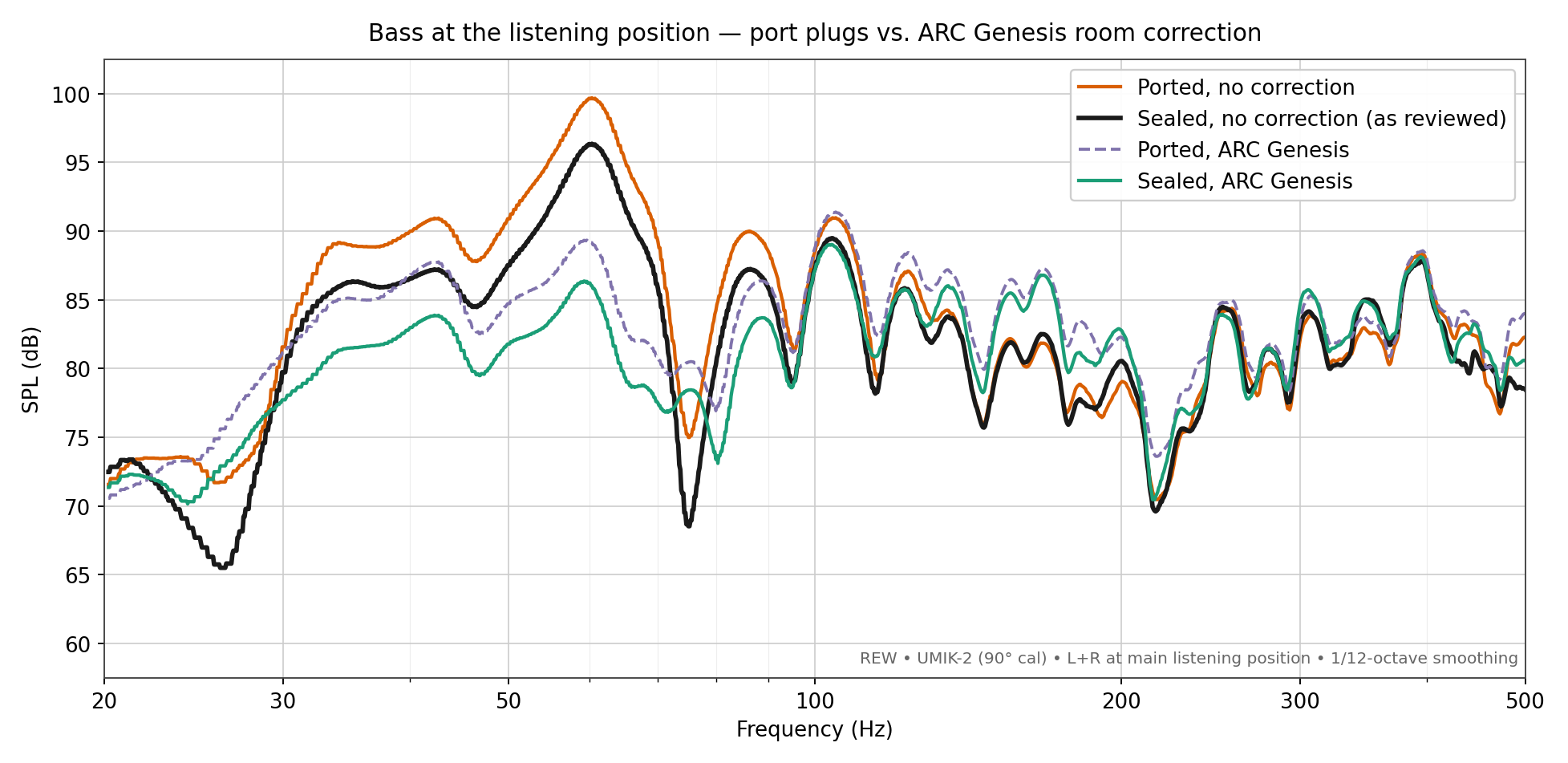
At my seat, sealing the cabinets cost surprisingly little deep-bass extension. Compared with the ported configuration, output at 30Hz fell by less than 2dB. Through most of the 35-to-80Hz band, however, the reduction was closer to 3 to 4dB, including about 3.3dB at the 60Hz peak. Above roughly 100Hz, the ported and sealed responses largely converged. In this room, reinforcement at this listening position did much of the heavy lifting either way.
ARC was much less subtle. With the plugs in, correction reduced the 60Hz mode by about 10dB and brought the average level of the 30-to-80Hz band into line with the midrange. It did not make that band itself flat; the narrower room-induced peaks and cancellations remained. Across 25 to 300Hz, ARC reduced the total peak-to-trough swing from about 31dB to approximately 18.5dB.
ARC also left the 216Hz notch largely intact, nor should it have tried to fill it aggressively. Changing the speaker or listener geometry is the useful remedy for a deep null, not pouring more amplifier power into it. Dips are where EQ goes to die.
ARC produced the flatter graph. I nevertheless preferred the uncorrected broad balance; to my ear, the relatively narrow 60Hz excess was less objectionable than losing the bass shelf as a whole. That is a preference, not a prescription, and Figure 2 makes the case for correction perfectly well.
The measurements also explained the subjective result that had begun to seem peculiar: sealed and subless, the 1610s never left me feeling short of bass.
The Sound
The 1610s’ superpower is invisibility. At the levels I could use in this room, no obvious strain, driver handoff, or recurring tonal quirk called attention to the hardware. Images stayed fixed in space, dense mixes remained intelligible, and the cabinets ceased to matter. That is what I mean by invisibility.
The coherence is especially convincing. The 1610 sounds like one speaker, not three drivers occupying the same cabinet: no tweeter calling attention to itself, no boxed-in midrange, and no woofer behaving like an attached bass module. I cannot prove the curved baffle deserves the credit, but what I heard is consistent with its design intent.
Nothing in the tonal balance suggests the familiar five-minute-demo trick of a pushed presence region or gratuitous treble sparkle. The detail is there; the speaker simply does not underline it. Kick drums kept their impact, dense mixes stayed sorted, and the treble remained explicit without spraying fake air over everything.
I used music I know, most of it not selected for audiophile respectability. That is generally more revealing anyway.
Thievery Corporation, “Lebanese Blonde” (The Mirror Conspiracy)
The sitar riff detached from the baffles and sat dead center, slightly forward. The flute, breathy vocal, and shaker parked out wide each occupied a distinct pocket of space. In the sealed configuration, the bass line stayed round and warm without becoming bloated. It may be lounge music, but the arrangement rewards a speaker that can keep track of it.
The Orb, “Little Fluffy Clouds” (The Orb’s Adventures Beyond the Ultraworld)
I have used “Little Fluffy Clouds” for years because a mediocre speaker turns it into a pleasant wash. The 1610s kept the spoken sample fixed at center while the synths, chirping effects, and harmonica figure occupied distinct positions and depths. The kick had genuine weight, the stage extended beyond the cabinets, and it did not wobble.
Bassnectar, “Bass Head” (Timestretch)
“Bass Head” answered the subwoofer question. Sealed, with ARC off, the 1610s reproduced its low-frequency layers as separate events rather than one enormous thump. The bass hit in proportion, stopped when it should, and showed no audible strain at the levels my apartment permits.
The Beatles, “Come Together (2019 Mix)” (Abbey Road)
I have known every bar of “Come Together” for almost 50 years, which makes it more useful to me than any audiophile spectacular. Through the 1610s, the 2019 mix sounded modern, full-bodied, and tonally right. The guitar entrance in the chorus still had the ability to wake me up, but nothing else in the balance asked for attention. Familiarity is ruthless, and the 1610s gave me nothing to argue with.
Tones on Tail, “Go! (Club Mix)” (Lions/Go! – Single)
“Go!” is not a polite recording. The sound is thick: crunchy guitar, that hiccupping vocal, and a rhythm section that plays as if it is in a small room directly in front of you. Tones on Tail were masters of studio sound, and the 1610s preserved the deliberate density without turning it into congestion.
Bill Laswell, “Lost Roads” (Hear No Evil)
I use “Lost Roads” to listen for low-level resolution and ambience rather than impact. The 1610s resolved the delicate percussion—airy shaker and muted strikes—while the resonant low end swelled and receded without obscuring it. The recording’s space replaced the apartment, which is exactly what a system is supposed to allow.
Beastie Boys, “Intergalactic” (Hello Nasty)
The robotic chorus effect spread wide and stayed rock-solid, while the stereo pans snapped hard left and right without smear. Underneath, the percussion remained crisp and the organ stabs had body. I could follow the three voices through the overlaps, each in its own position, without losing the words.
Movies and Games in Stereo
I also left the 1610s connected to the TV, because this was my living-room system rather than a temporary shrine to two-channel music. Dialogue locked to the screen, effects tracked laterally with precision, ambient cues spread well beyond the cabinets, and the bass gave action scenes useful scale. Two speakers do not reproduce effects overhead or behind you. Period. This is not Atmos by another name, but in an apartment it is a serious alternative rather than something I had to excuse.
The Case for Two Great Speakers
My argument is not that two channels equal Atmos. It is that quality and channel count compete when the budget is fixed. Spread $3,600 across an entire speaker package and a subwoofer and you gain spatial coverage; put it into a pair of 1610s and you gain refinement, coherence, and simplicity. I chose the latter in this room. The missing channels remained missing, but the trade never felt like deprivation.
A good subwoofer still buys output, placement flexibility, and easier bass management, and for a dedicated home theater I would still want one. For music in this room, at my levels, the 1610s did not leave me feeling shortchanged. The system also became simpler: two speakers, one receiver, no bass-management drama. I count that as value.
Nor does choosing 2.0 close off a future expansion. The matching Center 8 and wall-friendly Slim 8 make the Bookshelf 8 part of an AV-friendly family, even though it stands on its own as a stereo speaker.
Placement Advice
Start with the plugs if your room is small or the speakers must sit close to a wall. Not because sealed is automatically better, but because it is often easier to manage. My room already had more bass than I needed, and sealing brought it closer to balance. A larger, more open, or heavily damped room may prefer the ports open. That is the point of giving you both options.
About 20 degrees of toe-in sharpened the imaging for me without making the top end too direct. Treat that as a starting point, not a commandment. If you can give the speakers more than my six inches of breathing room, experiment with it, and with the listening position. The 216Hz notch was likely a tax imposed by my geometry, and EQ will not cure a deep cancellation. The room gets a vote.
ARC plainly improved the 60Hz mode and the overall bass evenness here. I simply preferred the uncorrected tonal balance during the review. Another room, or another listener, could easily make the opposite choice.
Highs & Lows
Highs
- Coherent, transparent presentation with stable imaging
- Port plugs provide useful sealed/vented flexibility for real rooms
- Exemplary build, finish, and, yes, even the packaging
Lows
- 85dB sensitivity into 4 ohms calls for a capable amplifier
- Big and heavy for a “bookshelf”; budget for stands
- $3,600/pair is premium territory for this site
Verdict
The Arendal 1610 Bookshelf 8 sits at the premium end of what Audiophiles on a Budget covers, but this is not decorative luxury. The money buys cabinet construction, capable drivers, disciplined engineering, and unusually few sonic problems. Arendal’s direct-sales model, 60-day audition, and 10-year warranty make the price easier to defend.
What impressed me was not one spectacular trick but the absence of anything that required an excuse: no thin midrange to forgive, no hot treble to tame, and no bottom-end deficiency to explain away.
That is why I chose the 1610s to open this independent chapter of Audiophiles on a Budget. They are not revolutionary; they are exceptionally evolved. In a 13-by-20-foot room, six inches from the wall, driven by an Anthem MRX SLM rated at 92 watts per channel into 4 ohms with two channels driven, they provided never-ending sonic delights and kept a 35-year subwoofer devotee from missing his sub. I more than recommend them. I love them.
Where to Buy & Check Current Pricing
Check Arendal Sound 1610 Bookshelf 8 Review Pricing on Amazon Shop Top-Rated Hi-Fi & Home Theater Gear on Amazon
Disclosure: As an Amazon Associate, Audiophiles on a Budget earns from qualifying purchases at no extra cost to you.



I thoroughly enjoyed reading your review. In fact, I have been missing in-room measurements in most reviews. Sure, rooms are different, but we still get an idea of how the speakers will perform in a normal living room. Thank you!
Thanks for reading, Stefan! Anechoic spinorama data is great for showing what a speaker does in free space, but real living rooms add boundary gain and floor bounce that you always hear from the listening chair. Seeing both the gated behavior and the actual in-room curve gives a much clearer picture of how easy a speaker is to integrate.