
Klipsch Rebuilds The Fives II, The Sevens II, and The Nines II Around Onkyo Electronics and Dirac Live
First-generation versions of Klipsch’s Heritage-inspired powered monitors—The Fives, The Sevens, and The Nines—packed plenty of horn-loaded punch and an HDMI ARC port, but they lacked Wi-Fi network streaming and room calibration. For its 80th anniversary year (Paul W. Klipsch founded the company in a Hope, Arkansas, tin shed in 1946), Klipsch went to Corporate sibling Onkyo to completely gut and rebuild the internal electronics.
First previewed at CES 2026 and rolling out across three sizes—The Fives II ($1,399.99/pair), The Sevens II ($1,999.99/pair), and The Nines II ($2,399.99/pair)—the second-generation models integrate an Onkyo AV receiver platform directly into the primary speaker cabinet.
BMC Horn Baffles and Jet Cerametallic Cones
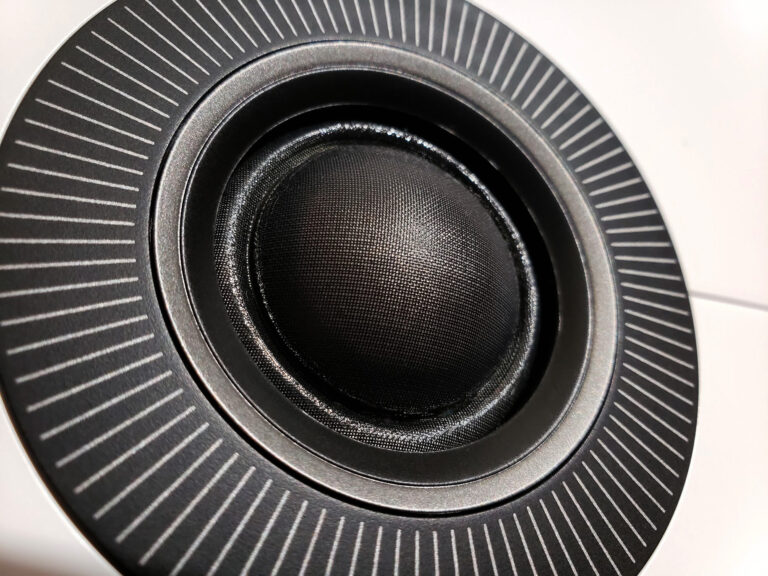
Acoustically, all three models replace the flat MDF front board of their predecessors with a denser, one-piece Bulk Molding Compound (BMC) baffle. The curved-radius BMC molding forms a continuous 90° × 90° Tractrix horn lens with minimal edge diffraction, mated to a 1-inch titanium dome tweeter on Klipsch’s Linear Travel Suspension (LTS) surround. Low frequencies come from redesigned Jet Cerametallic woofers breathing through rear Tractrix ports: a 5.25-inch driver in The Fives II, a 6.5-inch driver in The Sevens II, and an 8-inch driver in The Nines II.

Another practical fix arrives in the umbilical cord between the two cabinets. Earlier models used a proprietary multi-pin DIN cable that was a headache to fish through walls or replace at longer lengths. As noted in the official user manuals for The Fives II, The Sevens II, and The Nines II, all three Gen II systems now link the powered primary speaker to the passive secondary speaker via a single standard USB-C interconnect—or wirelessly on The Sevens II and The Nines II when both cabinets are plugged into AC power.
Dirac Live, HDMI 2.1 Pass-Through, and Balanced XLRs

Because the internal board is built on Onkyo’s AVR architecture, all three speakers decode Dolby Atmos (with DTS:X added on The Nines II) and include both an HDMI eARC output and a dedicated HDMI 2.1 input supporting 8K or 4K/120Hz video pass-through. Network streaming runs over built-in Wi-Fi or Ethernet via the Klipsch Connect Plus app with Apple AirPlay 2, Google Cast, Spotify Connect, TIDAL Connect, Qobuz Connect, Roon Ready certification, and two-way Bluetooth 5.4.
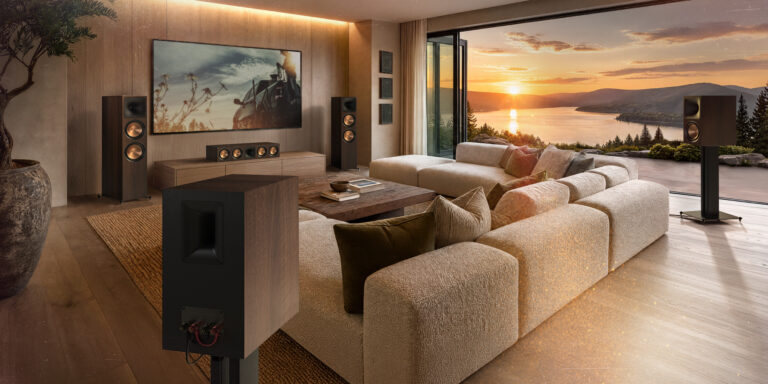
Both The Sevens II and The Nines II bundle a calibration microphone and a built-in Dirac Live Room Correction (Limited Bandwidth) license to tame low-frequency room modes below the Schroeder frequency. Analog connections across the trio include stereo RCA line inputs and a dedicated moving-magnet phono input with ground lug (no shared switch required), while The Nines II adds balanced XLR left and right inputs for studio interfaces or balanced preamps. Real wood veneer finishes include Walnut, Ebony, and a new Red Oak option paired with a white baffle and beige fabric grilles.
Klipsch Gen II Powered Speakers Specifications
| Specification | The Fives II ($1,399.99) | The Sevens II ($1,999.99) | The Nines II ($2,399.99) |
|---|---|---|---|
| Tweeter & Horn | 1 in (25.4 mm) titanium LTS tweeter on BMC 90° × 90° Tractrix horn | 1 in (25.4 mm) titanium LTS tweeter on BMC 90° × 90° Tractrix horn | 1 in (25.4 mm) titanium LTS tweeter on BMC 90° × 90° Tractrix horn |
| Woofer | 5.25 in (133.4 mm) Jet Cerametallic cone | 6.5 in (165.1 mm) Jet Cerametallic cone | 8.0 in (203.2 mm) Jet Cerametallic cone |
| Frequency Response | 50 Hz – 25 kHz (±3 dB); -6 dB at 46 Hz | 39 Hz – 25 kHz (±3 dB); -6 dB at 35 Hz | 31 Hz – 25 kHz (±3 dB); -6 dB at 28 Hz |
| Maximum Output | 103 dB (1 m half-space) | 106 dB (1 m half-space) | 107 dB (1 m half-space) |
| Room Correction | App EQ presets | Dirac Live Limited Bandwidth (mic included) | Dirac Live Limited Bandwidth (mic included) |
| Surround Decoding | Dolby Atmos | Dolby Atmos | Dolby Atmos, DTS:X |
| Speaker-to-Speaker Link | Wired USB-C link cable | Wired USB-C or wireless inter-speaker link | Wired USB-C or wireless inter-speaker link |
| Analog Inputs | Stereo RCA Line, Dedicated MM Phono RCA, 3.5 mm Aux | Stereo RCA Line, Dedicated MM Phono RCA, 3.5 mm Aux | Balanced XLR (L/R), Stereo RCA Line, Dedicated MM Phono RCA, 3.5 mm Aux |
| Digital & Video I/O | HDMI 2.1 In (8K/4K120), HDMI eARC Out, USB-C Audio (24-bit/96 kHz), Optical, Coaxial, Sub Out | HDMI 2.1 In (8K/4K120), HDMI eARC Out, USB-C Audio (24-bit/96 kHz), Optical, Coaxial, Sub Out | HDMI 2.1 In (8K/4K120), HDMI eARC Out, USB-C Audio (24-bit/96 kHz), Optical, Coaxial, Sub Out |
| Wireless & Streaming | Wi-Fi, AirPlay 2, Google Cast, Spotify/TIDAL/Qobuz Connect, Roon Ready, Bluetooth 5.4 | Wi-Fi, AirPlay 2, Google Cast, Spotify/TIDAL/Qobuz Connect, Roon Ready, Bluetooth 5.4 | Wi-Fi, AirPlay 2, Google Cast, Spotify/TIDAL/Qobuz Connect, Roon Ready, Bluetooth 5.4 |
| Dimensions (H × W × D) | 12.1 × 7.0 × 9.6 in (308 × 178 × 243 mm) | 15.6 × 8.5 × 11.4 in (396 × 216 × 290 mm) | 18.3 × 9.75 × 13.7 in (465 × 248 × 348 mm) |
| Weight (Primary / Secondary) | 14.15 lbs / 12.15 lbs | 24.65 lbs / 22.45 lbs | 31.2 lbs / 29.05 lbs |
| Finishes | Walnut, Ebony, Red Oak | Walnut, Ebony, Red Oak | Walnut, Ebony, Red Oak |