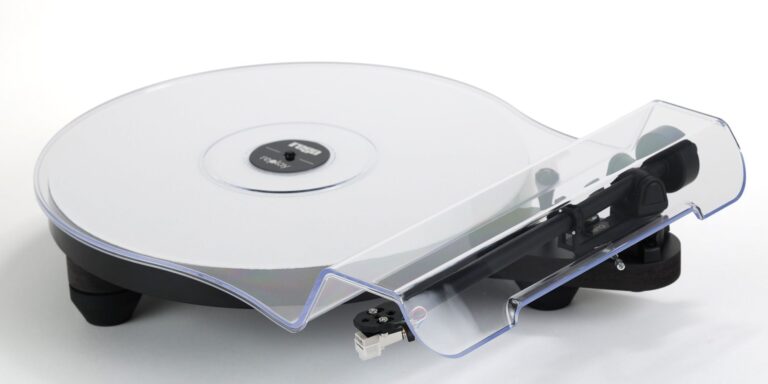

NAD C 359S Returns to Class AB Amplification With BluOS Streaming and Physical Controls for $1,299
For the past decade, nearly every integrated amplifier in NAD Electronics’ Classic and Masters lines has relied on Hypex or Purifi Class D output modules, often behind a glass touchscreen. With the new $1,299 C 359S Integrated Streaming Amplifier, announced on October 15, 2026 alongside the matching $999 C 569 CD player, NAD swings the pendulum back to Class AB output transistors and physical rotary knobs.
From the 1978 NAD 3020 to a Switch-Mode Class AB Stage
Founded in London in 1972 as New Acoustic Dimension, NAD built its reputation on late Chief Engineer Bjørn Erik Edvardsen’s 1978 Model 3020—a modest 20-watt Class AB integrated amp that could drive reactive, low-impedance loudspeaker loads without wilting. According to NAD Product Manager Morten Nielsen, the C 359S updates that formula by pairing a newly designed Class AB output stage with a high-current, low-noise switch-mode power supply (SMPS) adapted from NAD’s flagship Masters Series.
Built on a four-layer printed circuit board to shorten signal paths and isolate ground planes, the C 359S is rated in the official NAD C 359S datasheet for 70 watts per channel continuous into 8 ohms and 120 watts per channel into 4 ohms across a 20 Hz to 80 kHz bandwidth at less than 0.03% THD. Dynamic IHF power reaches 76 W into 8 ohms, 144 W into 4 ohms, and 210 W into 2 ohms, backed by more than 20 amps of peak current capability and a damping factor exceeding 210. NAD’s signature Soft Clipping circuit remains switchable, gently rounding waveform peaks when the volume knob gets pushed past polite limits.
Screen-Free Front Panel, BluOS & Hardware High-Pass Crossover
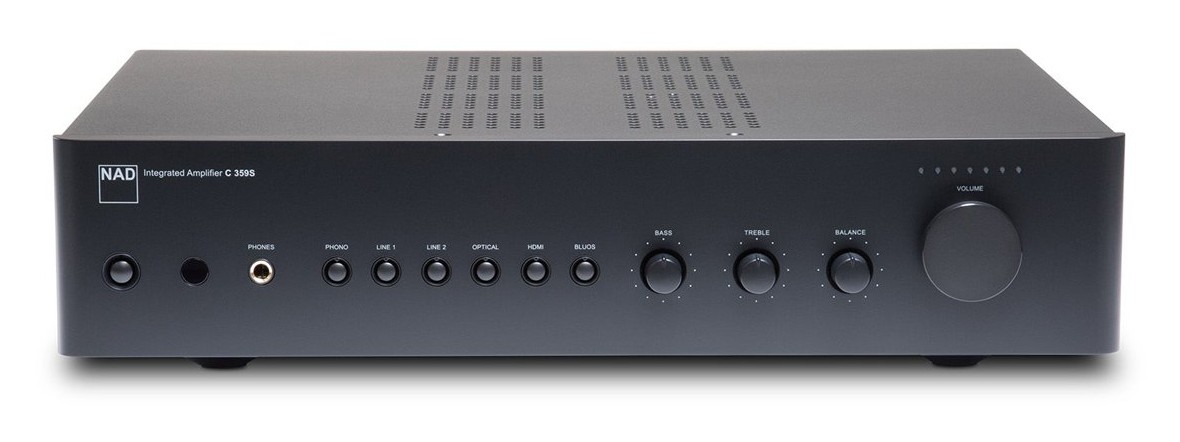
There is no LCD screen on the classic Graphite faceplate to age out or glow across a darkened listening room. Six push-buttons select between Phono, Line 1, Line 2, Optical, HDMI, and BluOS inputs, accompanied by a 6.35 mm headphone jack driven by a dedicated low-impedance (5-ohm) headphone amplifier. Four rotary controls handle Bass (±8.5 dB at 80 Hz), Treble (±10 dB at 10 kHz), channel Balance, and Volume, with a Tone Defeat option for a flat pass-through.

Inside, Lenbrook’s BluOS module handles network streaming up to 24-bit/192 kHz PCM over Wi-Fi 5 or Gigabit Ethernet, with native support for Spotify Connect, TIDAL Connect, Qobuz Connect, Apple AirPlay 2, Roon Ready, and two-way Bluetooth 5.0 aptX HD. Digital inputs are pared down to the two jacks most living-room systems actually use: one HDMI eARC port for television audio and one Optical TOSLINK input.
Analog listeners get two stereo RCA line inputs (Line 1 and Line 2) and a dedicated moving-magnet phono stage (46 kilohms / 100 pF input load, >82 dB A-weighted signal-to-noise ratio) with RIAA equalization and a 50 kHz Neumann ultrasonic pole. One practical touch on the rear panel is a physical slide switch next to the subwoofer pre-out: flipping it to “With Sub” engages an 80 Hz high-pass crossover on the main speaker binding posts, relieving compact bookshelf speakers of deep bass excursions without digging through a mobile app menu.
NAD C 359S Specifications
| Specification | Details |
|---|---|
| Amplifier Topology | Class AB output stage with Masters-derived low-noise switch-mode power supply (SMPS) and switchable Soft Clipping |
| Continuous Power Output | 2 × 70 W into 8 Ω; 2 × 120 W into 4 Ω (20 Hz–80 kHz at rated THD, both channels driven) |
| IHF Dynamic Power | 76 W (8 Ω) / 144 W (4 Ω) / 210 W (2 Ω) |
| Peak Output Current | > 20 A (1 Ω, 1 ms) |
| THD (20 Hz–20 kHz) | < 0.03% (250 mW to 70 W, 8 Ω and 4 Ω) |
| Signal-to-Noise Ratio | > 97 dB (A-weighted, 500 mV in, ref. 1 W out in 8 Ω) |
| Damping Factor | > 210 (ref. 8 Ω, 20 Hz–6.5 kHz) |
| Streaming & Wireless | BluOS (up to 24-bit/192 kHz, MQA), AirPlay 2, Spotify/TIDAL/Qobuz Connect, Roon Ready, Wi-Fi 5, Gigabit Ethernet, Bluetooth 5.0 aptX HD (receive) |
| Digital Inputs | 1 × HDMI eARC, 1 × Optical TOSLINK, 1 × USB Type-A (external storage) |
| Analog Inputs | 1 × MM Phono RCA (46 kΩ / 100 pF, >82 dB SNR), 1 × Stereo Line RCA (>106 dB SNR) |
| Subwoofer Output & Crossover | 1 × RCA Subwoofer Pre-Out (100 Hz low-pass) with rear switchable 80 Hz high-pass filter for main speaker outputs |
| Headphone Output | Front 6.35 mm (1/4 in) jack, 5 Ω output impedance, >110 dB SNR |
| Control & Integration | IR remote included, 12V trigger out, IR in; Control4, Crestron, RTI, URC, Lutron, KNX support |
| Dimensions (W × H × D) | 17.25 × 4.0 × 15.25 in (435 × 100 × 400 mm) |
| Weight | 19.6 lbs (8.9 kg) net / 23.1 lbs (10.5 kg) shipping |
| Price & Availability | $1,299 USD / $1,599 CAD / £1,099 GBP / €1,199 EUR; available now |