KEF LS LUXE Explained: Inside the $4,000 Wireless Speaker System
KEF’s sculptural LS LUXE puts streaming, amplification and motion feedback inside a $4,000 stereo system. Its most interesting engineering happens between the amplifier and the moving cone.
Ross Lovegrove has given the KEF LS LUXE the sort of curves that can turn a speaker into a room’s conversation piece. At $3,999.99 per pair, the conversation will eventually get around to what the money buys. The answer starts with a larger Uni-Q driver and an amplifier that receives information about how that driver is actually moving.
Introduced in July 2026, LS LUXE occupies the premium standmount position above the LS50 Wireless II in KEF’s wireless range. The price includes the network player and digital processing, plus dedicated amplifiers for each driver section. No external power amplifier is required. KEF’s current US listing puts the optional S-LUXE stands at another $799.99 per pair, bringing that combination to $4,799.98 before tax.
Updated November 7, 2026. This technical overview draws on manufacturer documentation and identified published reviews. The comparative measurements below are KEF’s.
KEF LS LUXE at a glance
| Item | Specification |
|---|---|
| US price | $3,999.99 per pair; S-LUXE stands: $799.99 per pair |
| Configuration | Two-way active stereo system; 12th-generation Uni-Q with MAT |
| Drivers, per speaker | 6.5-inch aluminum mid/bass cone; 1-inch vented aluminum-dome tweeter |
| Amplifiers, per speaker | 280W Class D for mid/bass; 100W Class AB for treble |
| Frequency response | 42 Hz–28 kHz (±3 dB); 35 Hz–47 kHz (−6 dB) |
| Measurement conditions | Frequency figures measured at 85 dB/1 m; depend on EQ settings |
| Network input | Up to 24-bit/384 kHz PCM; DSD files supported |
| Speaker-to-speaker link | All sources resampled to 24-bit/96 kHz PCM wirelessly, or 24-bit/192 kHz by cable |
| Dimensions, each (H × W × D) | 336 × 223 × 298 mm; 13.2 × 8.8 × 11.7 inches |
| Weight | 20 kg/44.1 lb per pair |
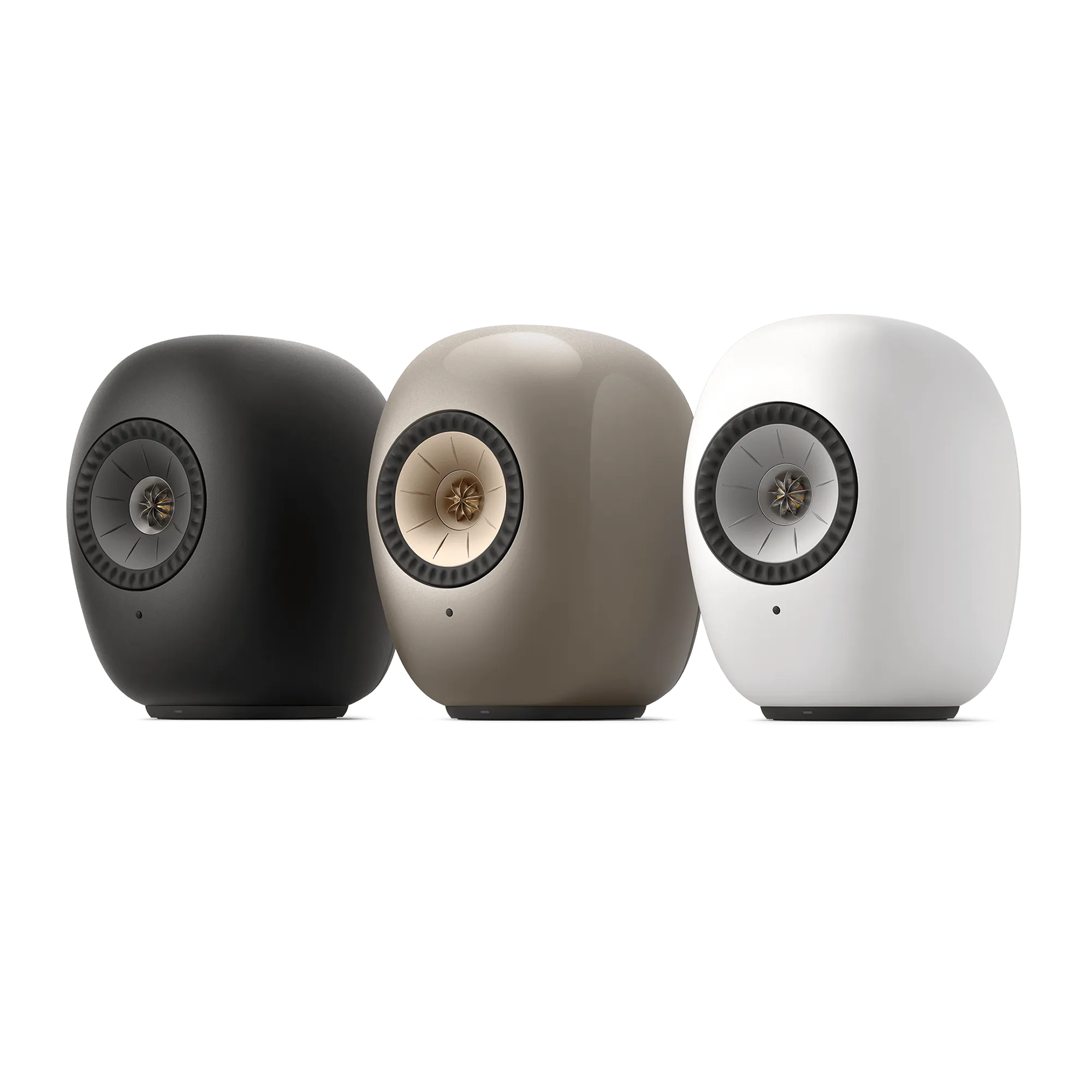
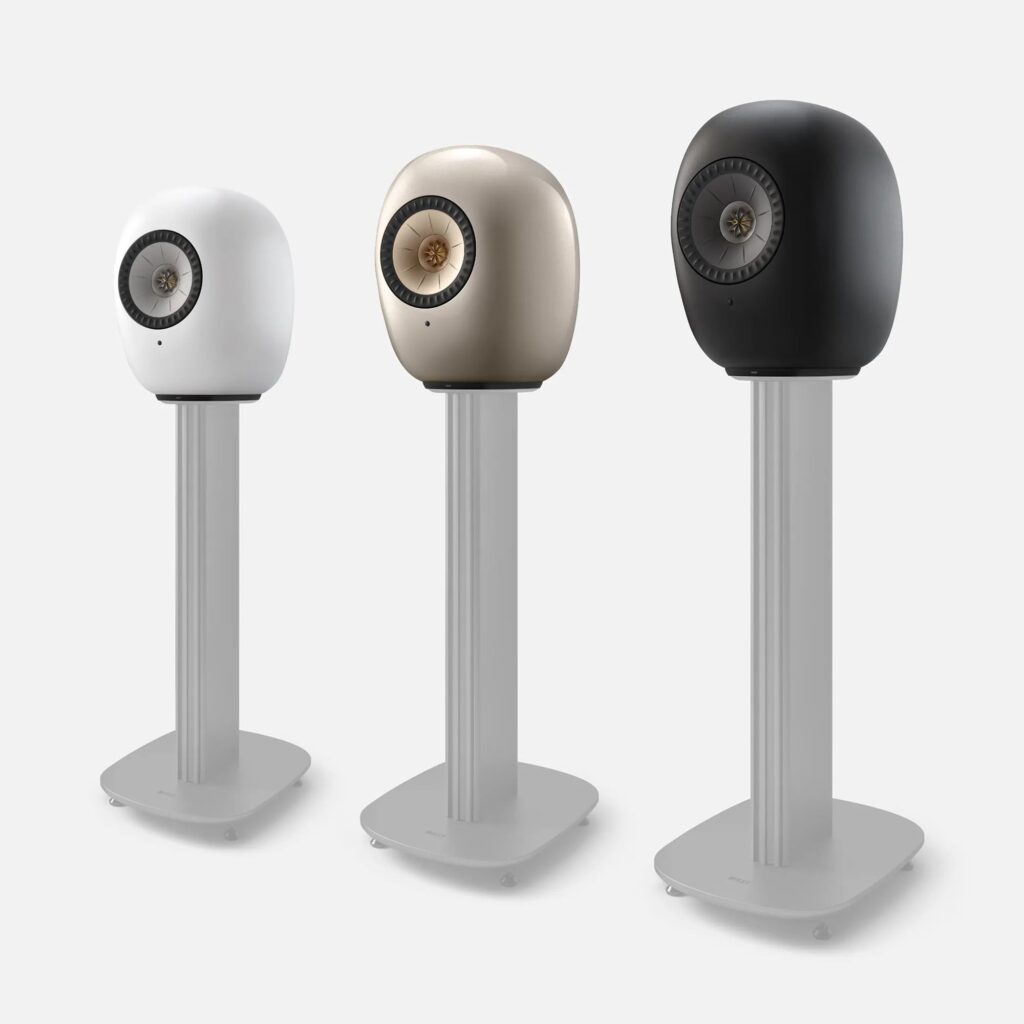
| Finishes | Eclipse Black, Mineral White and Dusk Titanium |
Specifications: KEF information sheet and US product listing. A frequency limit measured 6 dB down describes a different tolerance from a ±3 dB response specification; 35 Hz should not be read as flat response to 35 Hz.
The shape has an acoustic job
Lovegrove’s rounded enclosure carries forward his sculptural work with KEF, including Muon. KEF’s comparison with the LS50 Wireless II describes a cabinet molded from bulk molding compound, or BMC, rather than a conventional rectangular box. The larger 6.5-inch mid/bass driver replaces the LS50 Wireless II’s 5.25-inch unit. The tweeter sits at the acoustic center of that cone, the defining arrangement of Uni-Q.
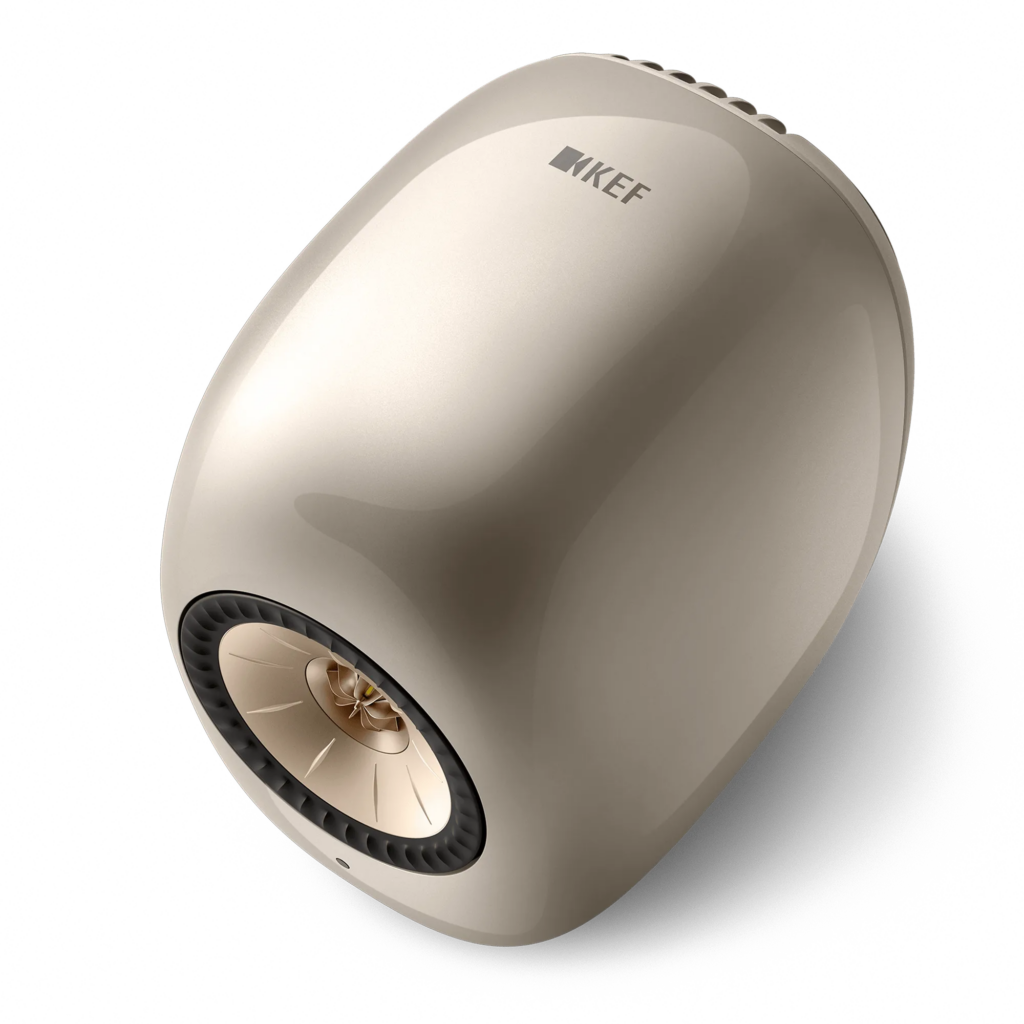
Sharp baffle edges can scatter sound and introduce additional arrivals at the listener. Smooth contours help reduce that diffraction. KEF also isolates the driver assembly mechanically to limit vibration passing into the cabinet. The aim is a cleaner contribution from the enclosure and more consistent radiation around the driver, rather than a cabinet that adds its own audible signature.
Behind the tweeter, Metamaterial Absorption Technology uses a labyrinth of tuned channels to absorb rearward sound. KEF’s 99% absorption claim concerns that unwanted rear radiation. It does not mean the speaker eliminates 99% of every kind of distortion, or corrects the acoustics of the listening room.
Why current drive matters
A moving-coil driver produces force when current flows through its voice coil in a magnetic field. Conventional amplifiers regulate voltage; the current that follows depends on the driver’s changing electrical impedance. Heat raises coil resistance, while movement changes other electrical properties. Both can complicate the relationship between the input signal and the cone’s motion.
LS LUXE uses current-drive amplification for both driver sections. Regulating coil current more directly is intended to reduce current-related distortion and thermal compression, the loss of output as the voice coil heats. Each speaker has a 280-watt Class D mid/bass amplifier and a 100-watt Class AB tweeter amplifier, totaling 760 watts across the stereo pair. Those wattage ratings alone cannot establish how loudly or cleanly the system will play. KEF’s Music Integrity Engine handles digital processing, including phase correction intended to improve timing through the system.
VECO closes the loop
Velocity Control Technology, or VECO, adds an electromagnetic sensor to the mid/bass driver. Its signal follows voice-coil speed and feeds back to the amplifier, allowing the drive signal to be corrected as the cone moves. This feedback supplies damping that current drive otherwise lacks around the driver’s low-frequency resonance.
The distinction matters: regulating current controls the electrical input, while velocity feedback checks the mechanical result. VECO is built into the driver; it is not a microphone listening to the room. The tweeter uses current drive without its own VECO sensor, with MAT providing acoustic damping behind its dome.
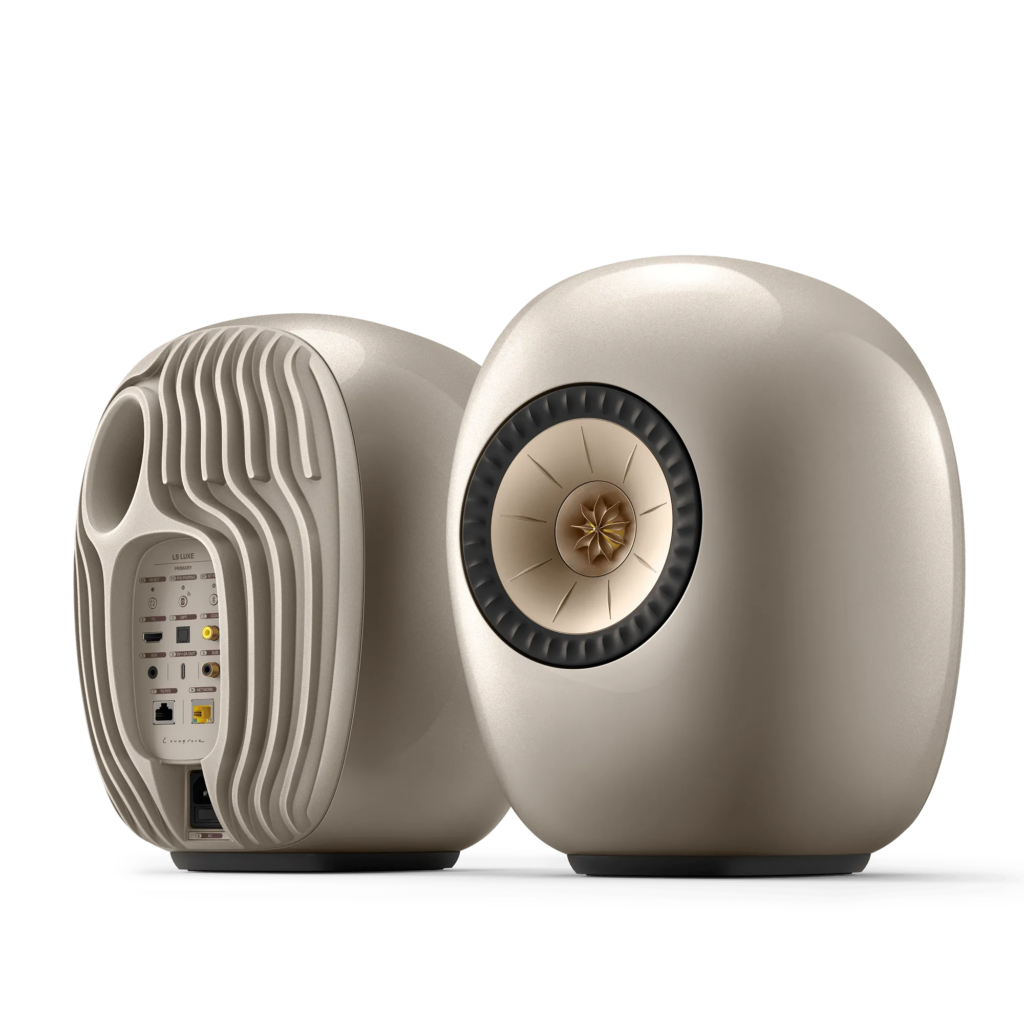
The LS LUXE also retains a bass-reflex port. At the rear, the opening sits within the folds of a large aluminum heatsink. KEF’s flexible port walls are designed to suppress resonances inside the port, while the heatsink carries heat away from the active electronics.
What KEF’s measurements actually show
The LS LUXE R&D paper reports approximately 50% more internal cabinet volume than the LS50. In a comparison with the LS50 Wireless II, level-matched at about 84 dB SPL at one meter, KEF reports roughly 8–10 dB more acoustic output below 40 Hz and a 6–14 dB reduction in bass and midrange total harmonic distortion. These are manufacturer test results under the paper’s stated conditions.
The low-bass comparison is a response measurement at that test level. It should not be turned into a claim that LS LUXE can play every bass note 10 dB louder before reaching its limits. Likewise, a reduction in measured distortion does not translate into a fixed percentage improvement in perceived sound quality. The measurements support a substantial engineering advance; room placement and listening level still affect the result.
A 384 kHz input is only one part of the signal path
The network input accepts PCM up to 24-bit/384 kHz, but the connection between the two speakers runs at a different rate. KEF specifies that all sources are resampled to 24-bit/96 kHz PCM with the wireless interspeaker link, or 24-bit/192 kHz PCM when the speakers are linked by cable. Both cabinets still require AC power.
A lossless source and a wireless connection can coexist. Resampling is a separate process from lossy compression, and a larger input sample-rate number does not by itself establish better audible performance. The practical choice here is between a cable-free speaker link and the higher interspeaker sample rate available by cable.
TV, vinyl and streaming: check the connections
The primary speaker has HDMI eARC, optical and coaxial digital inputs, plus 3.5 mm analog AUX and network Ethernet. KEF rates optical input up to 24-bit/96 kHz; coaxial and HDMI eARC reach up to 24-bit/192 kHz, subject to the source. The USB-C socket is a 5V/2A charging output, not a USB audio input.
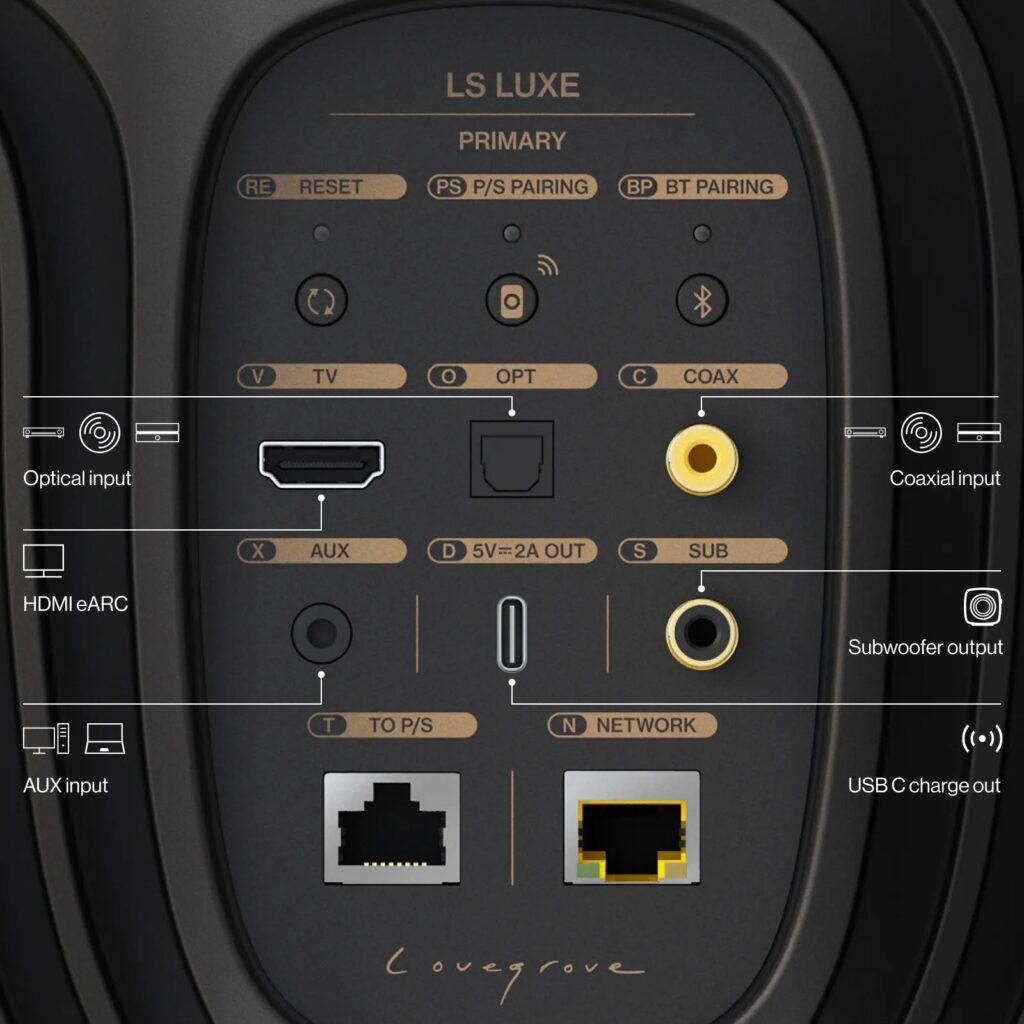
KEF’s quick-start guide instructs TV owners to select PCM output. Connect the speakers to the television’s ARC/eARC socket and check the TV’s audio menu if there is no sound. LS LUXE provides stereo playback; a multichannel Dolby or DTS bitstream should not be treated as a supported input format.
Vinyl connects through the line-level AUX input. A turntable needs either its own phono stage or an external one before that connection. The signal enters the speaker’s digital processing path, so this system will not suit someone seeking an entirely analog signal chain.
KEF’s W2 platform supports Spotify Connect, Tidal Connect and Qobuz Connect, alongside Amazon Music and Deezer. AirPlay and Google Cast provide additional playback and multiroom options; UPnP supports compatible local music servers. Bluetooth 5.3 is also listed in the official specifications. Available services vary by region.
Roon Ready remains a future feature. As of this update, KEF lists a 2027 release through a free over-the-air software update. Buyers who need certified Roon playback immediately should make their decision on that basis, rather than count a promised update as an available function.
Placement, EQ and adding a subwoofer
KEF Connect provides guided Normal and more detailed Expert setup. The controls include bass-extension choices, Wall and Desk settings, and Treble Trim. These are adjustments for placement and room balance, not a microphone-based automatic room-measurement system. They can help manage excess boundary reinforcement, but they do not make every location equally suitable.
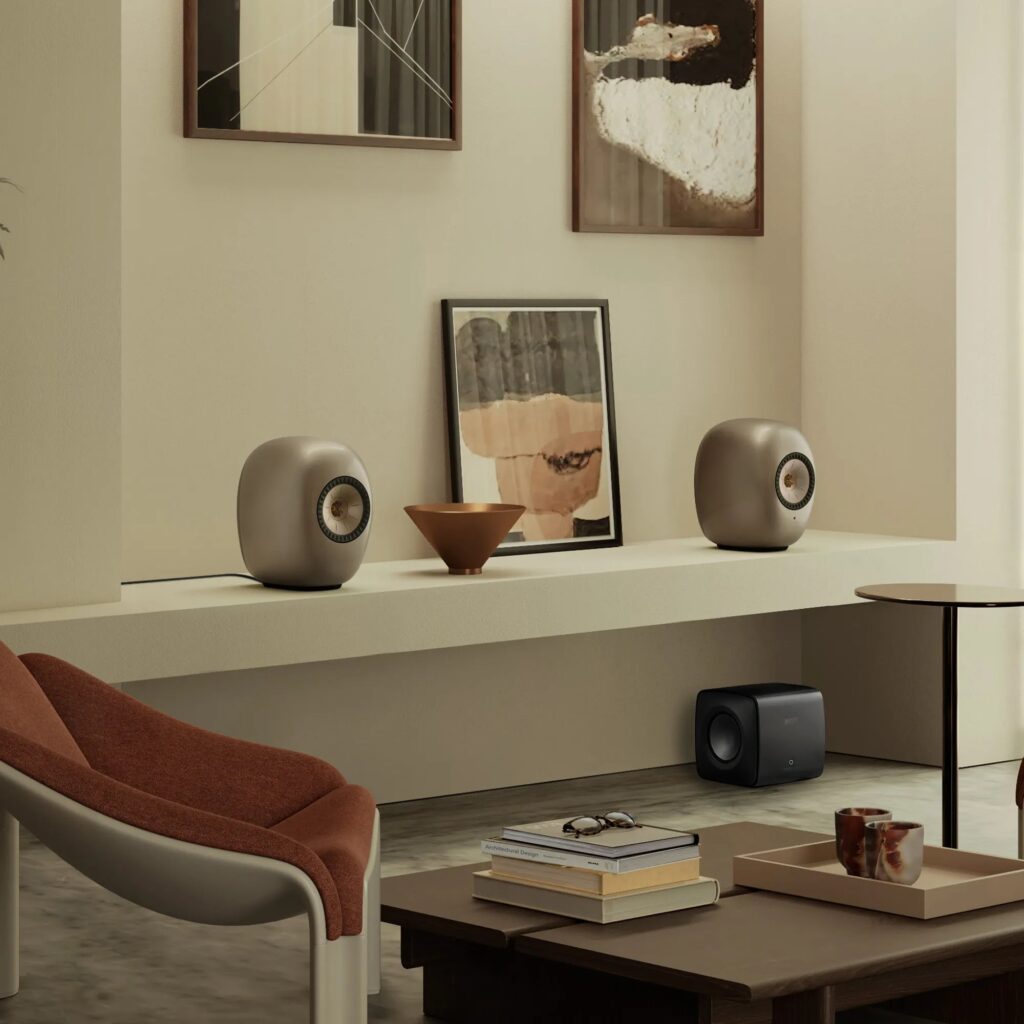
Each cabinet has an RCA subwoofer output, allowing one or two subs. KEF Connect includes integration presets for KEF models, and the optional KW1 adapter enables a wireless subwoofer signal connection. Adding a sub can extend the lowest octaves and, with the appropriate crossover settings, reduce deep-bass demands on the Uni-Q. Its purchase price belongs in the system budget.
The optional S-LUXE stands include cable management and come in Slate Grey. Their $799.99 price buys a purpose-built mounting solution; it does not make them compulsory. Furniture or other supports need to be stable and place the driver at a sensible listening height.
What listeners have reported
What Hi-Fi?’s published review describes a controlled, even tonal presentation and greater scale and detail than the LS50 Wireless II. Its reviewers used dedicated stands and the interspeaker cable, and preferred the speakers firing straight ahead around 30 cm from the rear wall in their test room. Those are useful audition notes, rather than a placement prescription for every home.
For an audition, include familiar voices and bass-heavy music at the volume normally used at home. Then move away from the center seat and listen again. That will reveal more about the usefulness of the dispersion and bass balance in that room than the appearance of a single spectacular demo track.
The value comparison has changed
The LS50 Wireless II remains a relevant alternative. On November 7, KEF’s US store showed $2,199.99 per pair, discounted from $2,999.99. At that promotional price, the gap to LS LUXE is $1,800. The smaller system already includes amplification and network playback, so the additional spending chiefly needs to justify the larger driver, enclosure and new driver-control engineering.
The floorstanding LS60 Wireless was listed at $5,999.99 per pair. Its dedicated bass drivers and specified 31 Hz–24 kHz response within ±3 dB give it a different low-frequency proposition. Once LS LUXE sits on its optional stands, the price difference to LS60 is approximately $1,200. Compare complete installed systems, especially if a subwoofer is also on the shopping list.
Against separates, the fair comparison includes the electronics required to reproduce the same functions. An existing amplifier and streamer can make passive speakers the more economical upgrade; a fresh installation may benefit more from KEF’s integration. The tradeoff is that amplification and streaming electronics stay tied to these cabinets. Future service and software support therefore matter alongside the acoustic design.
LS LUXE makes its strongest case for someone building a complete stereo system who values compact placement and wants the driver, amplifiers and processing engineered together. The current-drive and velocity-feedback combination provides a concrete reason for the premium. Whether it earns that premium for a particular listener depends on the audition, the room and the complete price with supports and any subwoofer included.
All product images: KEF. US prices checked November 7, 2026; promotions and availability can change.
Where to Buy & Check Current Pricing
Check KEF LS LUXE Pricing on Amazon Shop Top-Rated Hi-Fi & Home Theater Gear on Amazon
Disclosure: As an Amazon Associate, Audiophiles on a Budget earns from qualifying purchases at no extra cost to you.