Schiit Mani 3 Moves Phono Gain and Loading Controls to the Front Panel and Holds the Line at $149
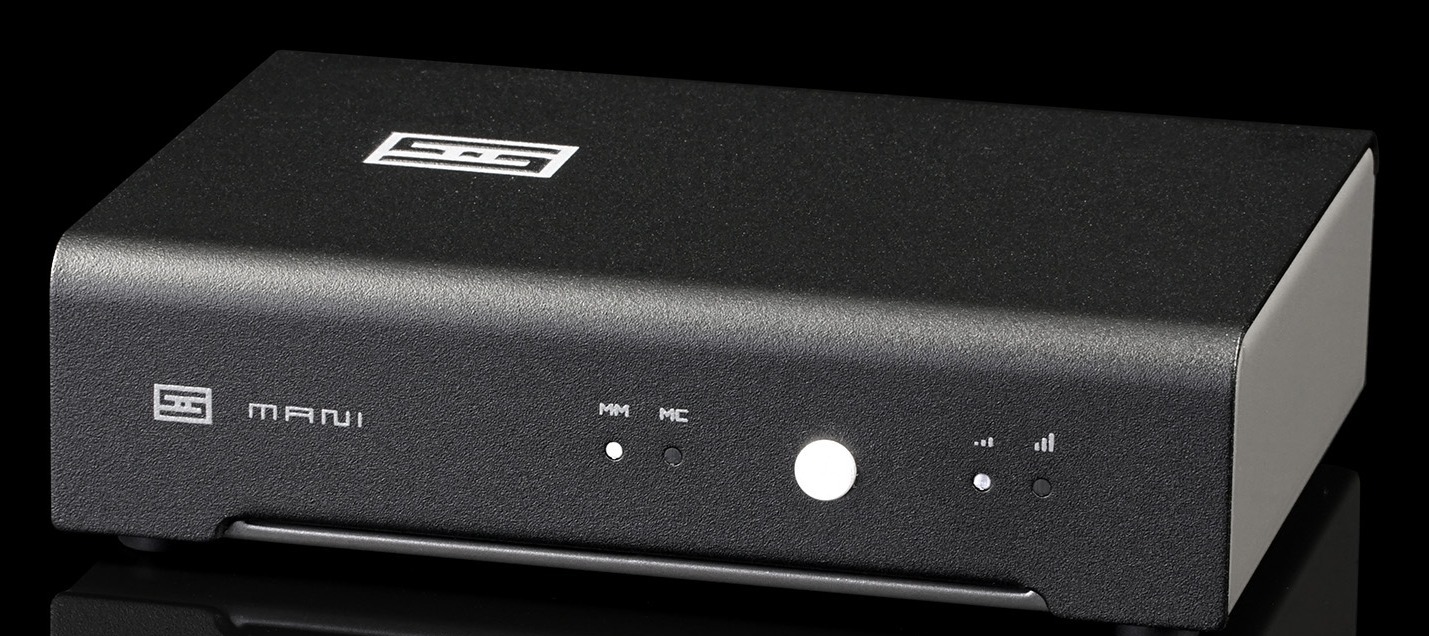
For the past twelve years, owning a Schiit Mani meant getting a lot of phono preamplifier for the money and an occasional workout flipping the chassis upside down to poke tiny DIP switches with a toothpick. With the new Schiit Mani 3, co-founders Jason Stoddard and Mike Moffat finally moved the primary gain and cartridge-mode controls to the front panel—and kept the price at $149.
Built on Schiit’s surface-mount production line in Corpus Christi, Texas, inside a California-stamped steel and aluminum enclosure, the Mani 3 is the third generation of a budget analog staple that first appeared at $129 in 2014 and evolved into the quieter, passive-RIAA Mani 2 in 2022. This time around, the usability overhaul comes alongside higher internal supply rails and a new active gain device.
Front-Panel Relay Switching and Rear Fine-Tuning
On the front faceplate, a microprocessor-controlled pushbutton toggles between standard Moving Magnet (47 kΩ / 50 pF) and Moving Coil (100 Ω / 50 pF) operation, as well as four gain levels: 30 dB (both gain LEDs off, ideal for high-output DJ or hotter MM pickups), 40 dB (left LED lit, standard MM default), 50 dB (right LED lit), and 60 dB (both LEDs lit for low-output MC cartridges). Rather than routing delicate cartridge-level signals through front-panel mechanical switches, the button triggers sealed relays right on the circuit board next to the signal path. As noted in the Schiit Mani 3 owner’s manual, the microprocessor mutes the output for a few seconds whenever you change gain so the DC-coupled circuit can settle without sending a 60 dB transient pop to your woofers.
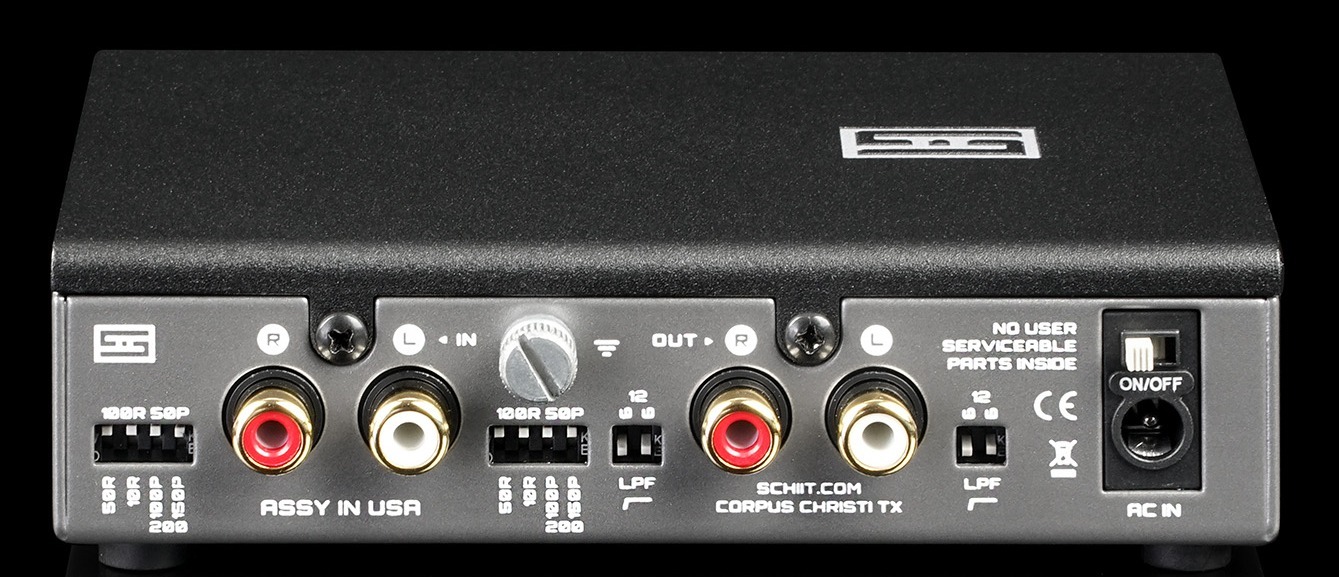
Instead of burying secondary loading switches underneath the belly of the unit, Schiit placed them on the rear panel between the gold-plated RCA jacks. When the front panel is set to MC mode, rear DIP switches let you dial in 10 Ω, 50 Ω, or 100 Ω input resistance, while capacitance can be stepped across 50 pF, 100 pF, 150 pF, or 200 pF. A separate two-pole switch engages a fully passive CR low-frequency rumble filter at 15 Hz with selectable 6 dB/octave or 12 dB/octave slopes to keep warped records from pumping bass-reflex bookshelf speakers.
AD4898 Gain Stages and ±17.5V Linear Rails
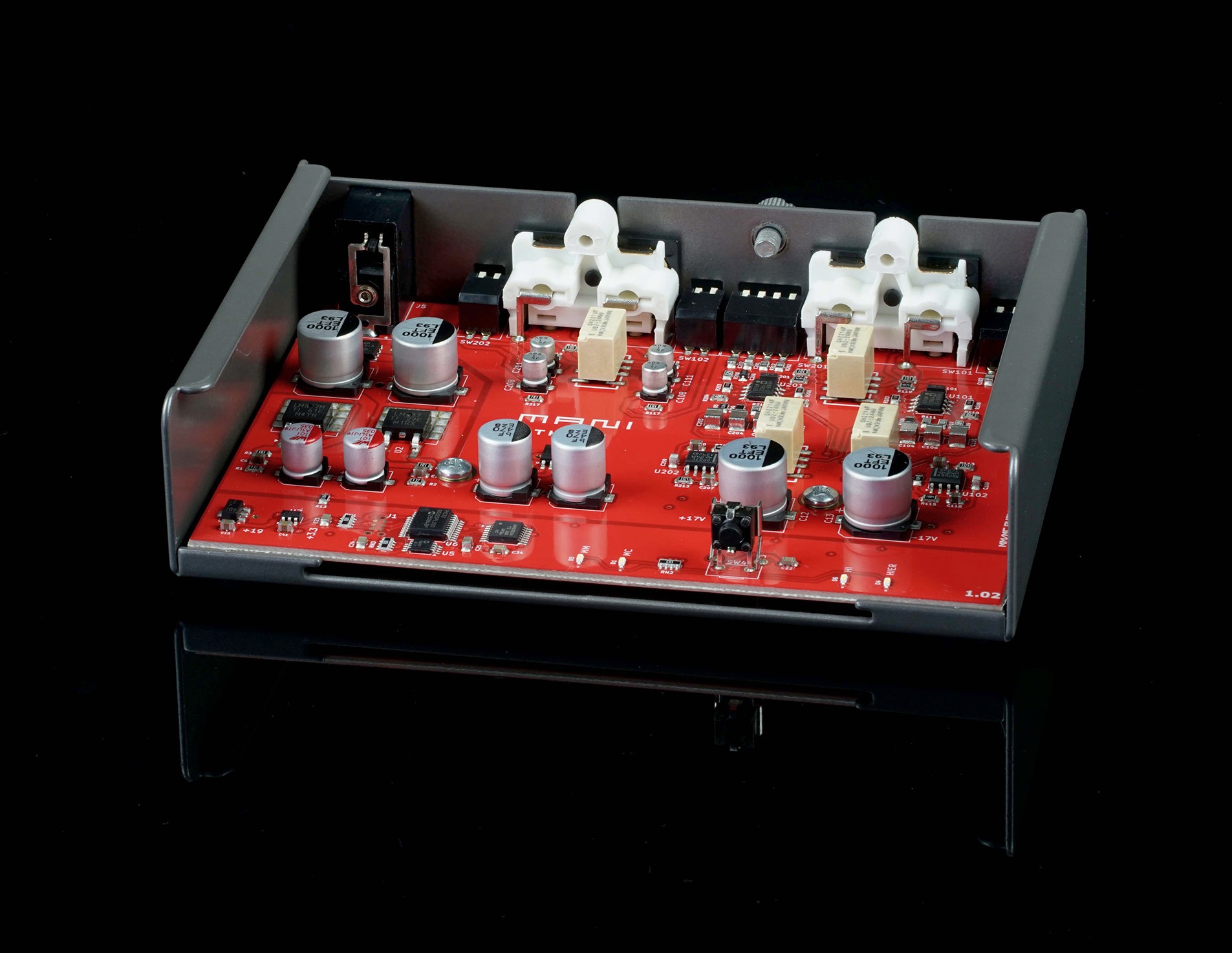
Inside, Schiit replaced the Texas Instruments OPA1612 op-amps of the Mani 2 with Analog Devices AD4898 ultra-low-noise high-voltage op-amps paired with an OP07 DC servo, eliminating coupling capacitors in the signal path. The passive RIAA equalization network uses 2% precision film capacitors and 0.1% thin-film resistors, tightening RIAA accuracy from ±0.2 dB on the Mani 2 to ±0.15 dB from 20 Hz to 20 kHz.
Power comes from an external 16VAC linear wall-wart transformer feeding internal dual-filtered voltage regulators that step the rails up from ±16V to ±17.5V—maintaining more than 20 dB of overload margin across all four gain settings, verified in Schiit’s published Audio Precision APx555 measurement report.
Schiit Mani 3 Specifications
| Specification | Details |
|---|---|
| Circuit Topology | Fully passive RIAA network (2% film caps, 0.1% thin-film resistors), Analog Devices AD4898 gain stages, OP07 DC servo, DC-coupled |
| RIAA Accuracy | ±0.15 dB, 20 Hz – 20 kHz |
| Gain Settings (Front Panel) | 30 dB, 40 dB (default MM), 50 dB, 60 dB via sealed relays |
| THD (A-Weighted, at 2V RMS) | < 0.0005% (30 dB) / < 0.0007% (40 dB) / < 0.001% (50 dB) / < 0.002% (60 dB) |
| SNR (A-Weighted, ref 2V RMS) | > 108 dB (30 dB) / > 100 dB (40 dB) / > 95 dB (50 dB) / > 87 dB (60 dB) |
| Crosstalk (20 Hz – 20 kHz) | -90 dB (30/40 dB) / -80 dB (50 dB) / -75 dB (60 dB) |
| Overload Margin | > 20 dB at all gain settings |
| Input Impedance | 47 kΩ (MM front default) or 100 Ω (MC front default); rear DIP selectable 10 Ω, 50 Ω, or 100 Ω |
| Input Capacitance | 50 pF default; rear DIP selectable 50 pF, 100 pF, 150 pF, or 200 pF |
| Low-Frequency Rumble Filter | Passive CR filter at 15 Hz: Bypass, 6 dB/octave, or 12 dB/octave (rear DIP switches) |
| Inputs & Outputs | 1 × stereo RCA phono input with ground post; 1 × stereo RCA line output (75 Ω output impedance) |
| Power Supply | External 16VAC 1A linear wall-wart; internal regulated ±17.5V rails (4 W consumption) |
| Dimensions & Weight | 5.0 × 3.5 × 1.25 in (127 × 88.9 × 31.8 mm); 1.0 lb (0.45 kg) |
| Warranty & Origin | 3-year limited warranty; built in Corpus Christi, Texas, USA |
| Price & Availability | $149 USD (Black); available now at schiit.com |