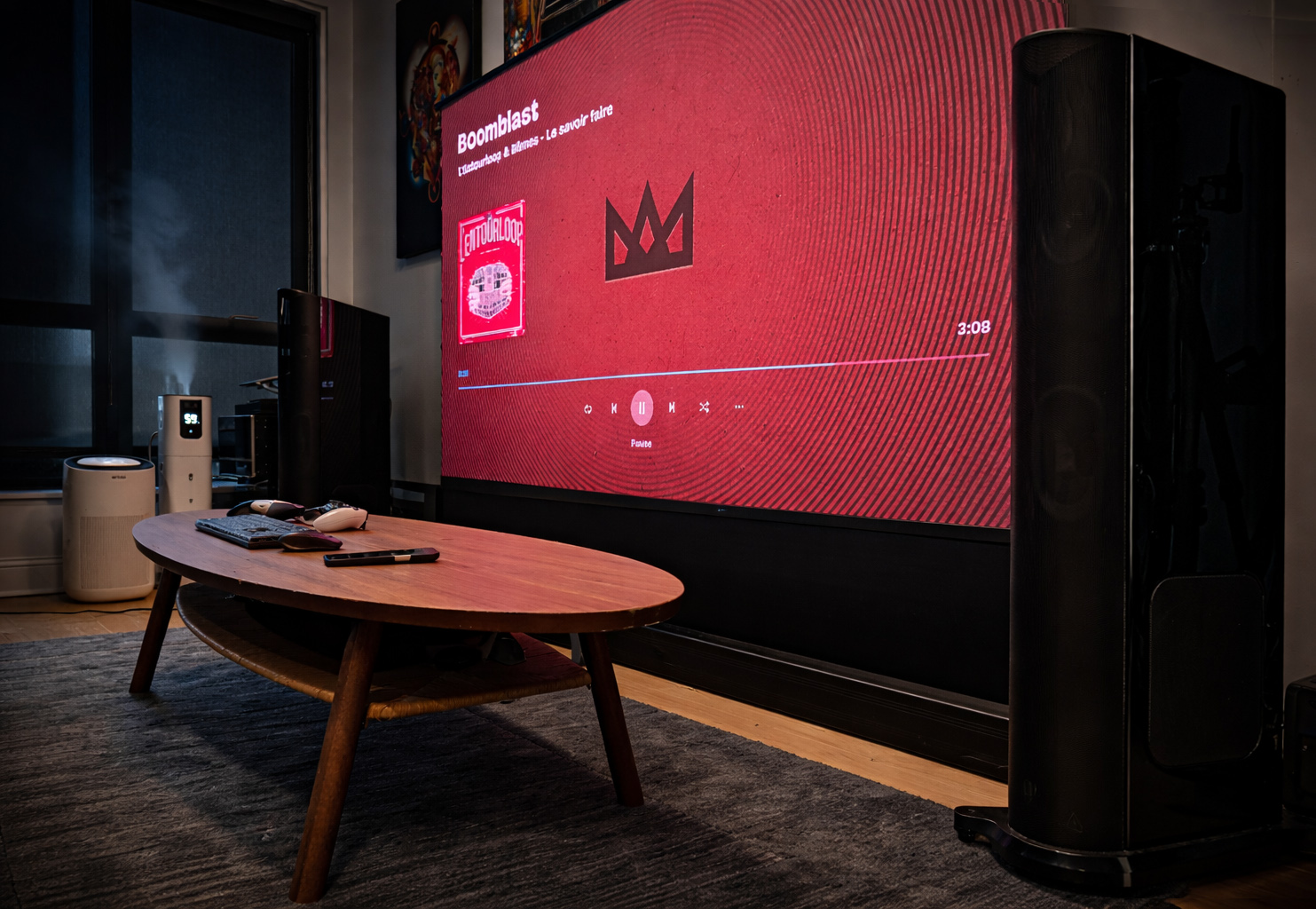
GoldenEar T44 Tower Speakers Hit the Sweet Spot
Are you familiar with GoldenEar? If not, here’s the scoop: It was founded by Sandy Gross, who also co-founded Polk Audio and Definitive Technology. Its speakers have a distinctive look that results from a consistent design philosophy informed by physics as well as aesthetics. Its speakers are in the premium category, but generally offer a high price/performance ratio along with decor-friendly looks.
This review of the GoldenEar T44 towers ($4,899/pair) is the first speaker review I’ve written for Audiophiles on a Budget, and as such represents a milestone. Back in December 2025, I left my job as Editor of Sound & Vision / Digital Editor at Stereophile.
My Audiophiles on a Budget group had been private for more than a decade as it grew to over 66,000 members. But for all that time it was private, with no option to convert it to public. However, in November 2025, Facebook changed that policy. Now AOAB is public, and I am independent.
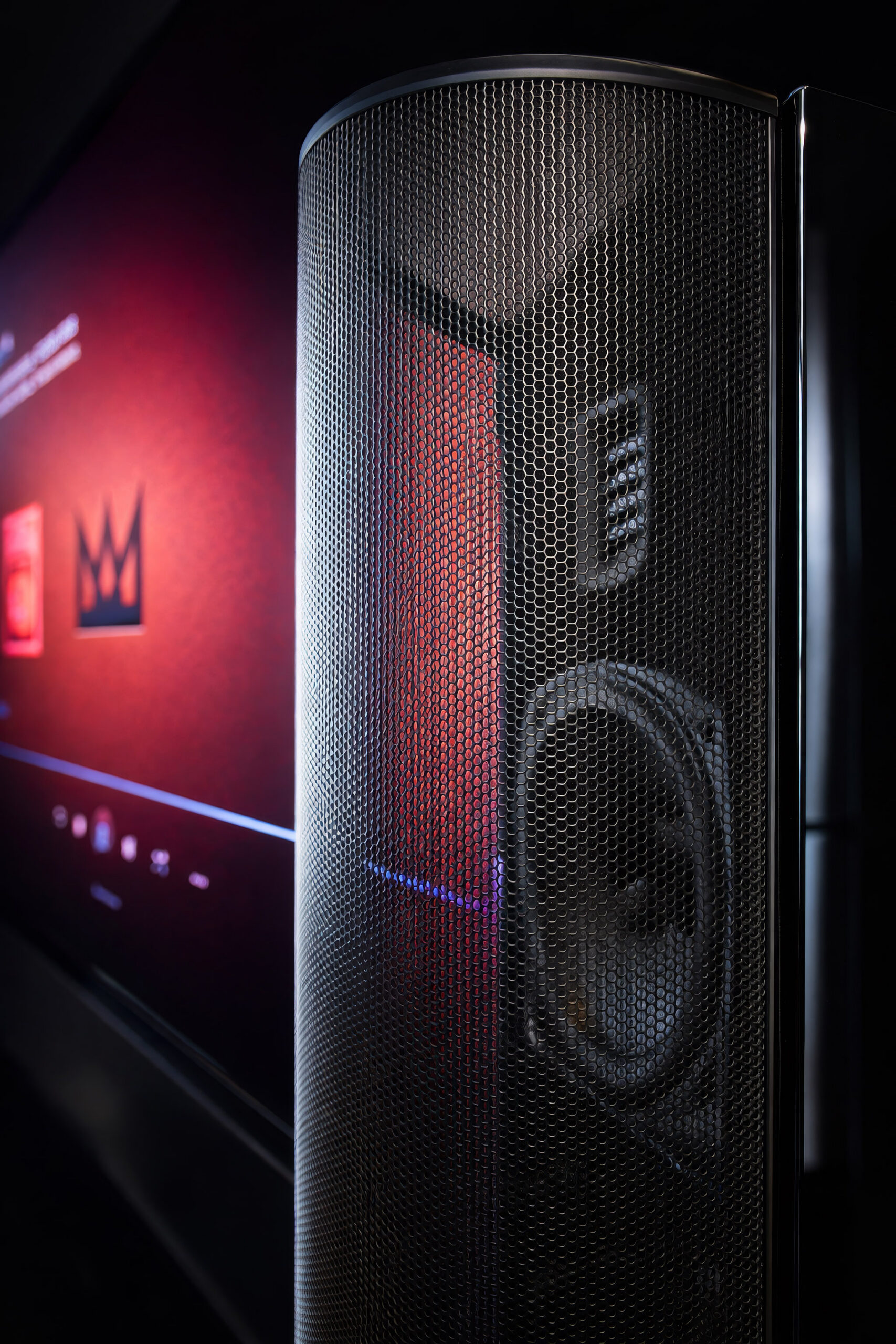
This piece also reflects my “IRL” reality when it comes to speaker reviews: I live in an urban apartment. The living room is small (11′ x 14′) and I have to be considerate of my neighbors. So my priorities tend to be a bit different than those who have standalone homes and dedicated listening rooms.
Most of all, I seek speakers that sound detailed and dynamic at modest listening levels. Speakers that stay composed when I crank the volume, but sacrifice nothing in terms of clarity at “nighttime” volume levels, where the low noise floor defines the dynamic range, as opposed to peak output. These demands are also why the Anthem MRX SLM proved an ideal partner for the T44s. It delivers on detail and dynamics while saving space with its compactness.
Bottom line, when it comes to standalone speakers (I rent, so no holes in the walls) saving floor space matters, appearances matter, and placement flexibility is a must. The system has to do it all, from music to movies to TV to gaming.
GoldenEar’s Canadian homecoming
Another reason this review feels like a personal milestone? GoldenEar is one of the first brands I reviewed when I was working at AVS Forum. I’ve enjoyed the sound of the Triton speakers so much, I wound up buying pairs of Triton Sevens to use as my “personal” speakers.
I still have those Triton Sevens, which were designed in Canada. Notably, the passive Triton Five and Triton Seven are still available, as is the Triton Reference.
Now, under the Paradigm/Anthem/MartinLogan umbrella, the brand is Canadian-owned. If you did not know, Canadians have done much to advance the science of good-sounding speakers! I even brought the Sevens out of storage to run a 4.1 configuration off the Anthem, although that is not the focus of this review. The truth is I’ve grown indifferent to surround-sound, ironic since I spent over 3 decades chasing more channels (hello, Atmos!). But now, I find a good stereo pair with a big screen in the middle gives me all the suspension of disbelief and dialog clarity I need to watch a movie. Of course I love multichannel home theater, but a good stereo system can do a lot of the heavy lifting if it images well and you are seated in the optimal listening zone.
GoldenEar’s T44s fit the bill perfectly because they project a holographic soundstage with depth, not just width. Imaging is detailed, speakers disappear acoustically. Sound placement is precise, and dialog comes from the screen and sounds natural. All achieved with just two speakers.
Architecture
The T44 is a 3-way design that leverages a powered bass section with a 5″ x 9″ “racetrack” woofer and an AMT (air motion transformer) folded-ribbon tweeter to nail the highs and lows. GoldenEar specifies internal amplification at 250 watts RMS.
GoldenEar’s T44 is a hybrid, semi-active floorstanding loudspeaker. Your receiver or amplifier handles the midrange and treble. Each tower includes an integrated amplifier for the bass, so your external amp can focus on the mids and highs. A dedicated DSP bass level control and passive radiators on each speaker extend and shape low-frequency output to taste, and to fit the room and placement.
This is a modern-looking, in fact strikingly handsome, slender tower design. The cabinet is wedge-shaped, with a sloped top, which eliminates parallel surfaces. It sports a curved metal grille that fully protects all the drivers: the T44 is a cat-proof speaker.
At the top of the driver array is GoldenEar’s HVFR (high-velocity folded-ribbon) tweeter (an AMT-style folded diaphragm design). The design goal is fast transient response and broad dispersion.
The midrange and mid-bass come from a single 4.5-inch cast-basket mid/bass driver. That differentiates it from the larger T66 tower (that I did review for Sound & Vision), which uses two mid/bass drivers in a D’Appolito array with the tweeter.
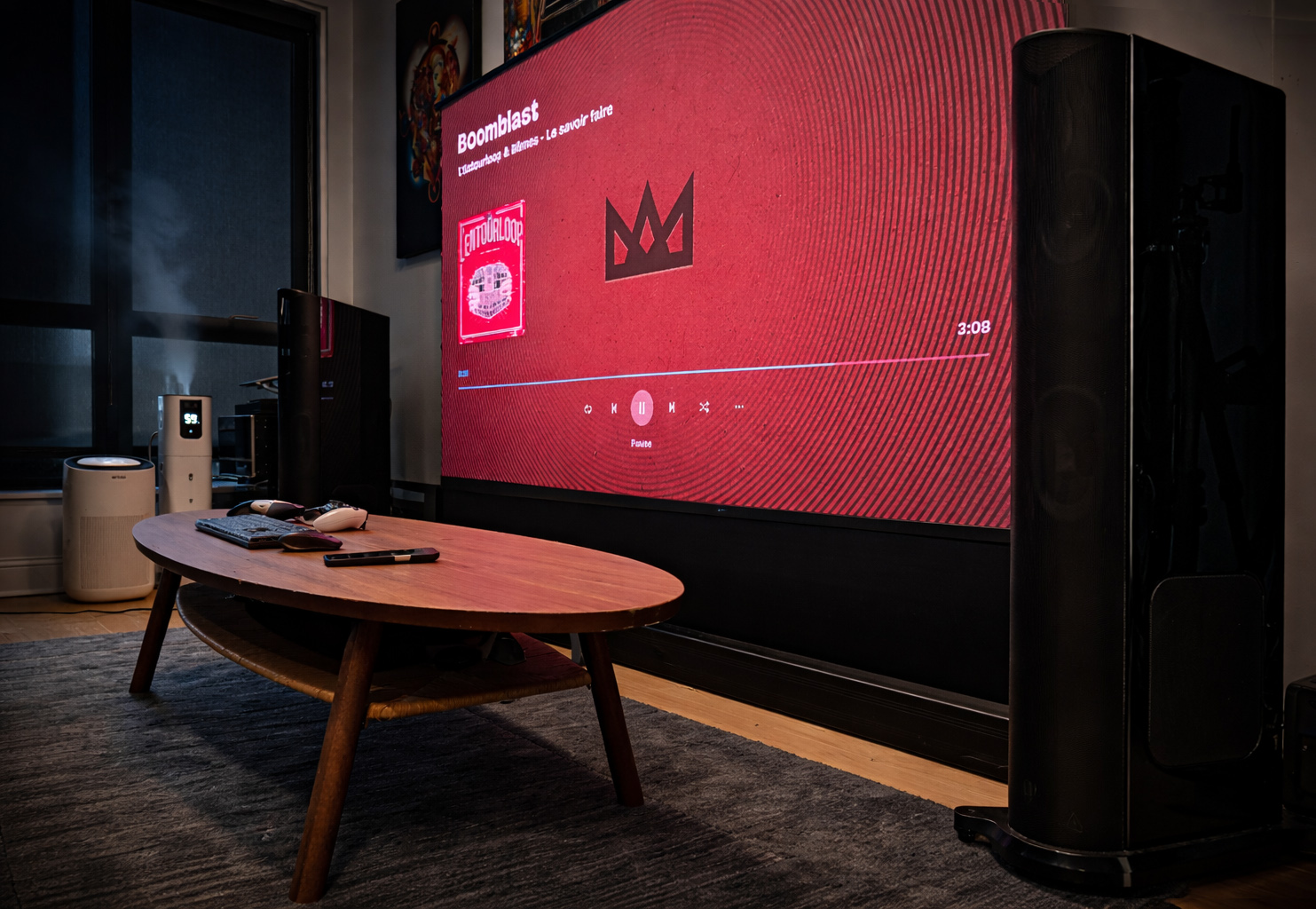
The cabinet is inert, and it sits on a full-footprint cast-aluminum base that accepts feet or spikes, to stabilize the speaker and help isolate it from the floor.
Setup in a small apartment
Smaller rooms tend to penalize speaker systems. Some towers require several feet of space from the wall to sound balanced. Others can lack impact when played at the lower output levels apartment life demands.
The T44 can deal with my reality because the bass system is self-powered and therefore adjustable at the speaker. Each tower has a Subwoofer Level control. In the manual, GoldenEar notes that left and right are normally set to the same level, but you’re free to set them differently to account for room effects (especially if you measure).
That adjustability, combined with the use of passive radiators rather than a rear-firing port, makes the T44 more forgiving near a wall than many large passive towers. Moreover, listeners can compensate for the effects of room gain. Pre-trimming the bass output before using room correction has the benefit of requiring that less EQ be applied by the room correction software. Or, for those who eschew room correction, you can get a good balance with simple measurements and some subjective tweaking.
The bottom line is the bass response of the T44 is largely independent of placement or room size, and that is a huge advantage when speaker placement is largely dictated by pragmatic concerns.
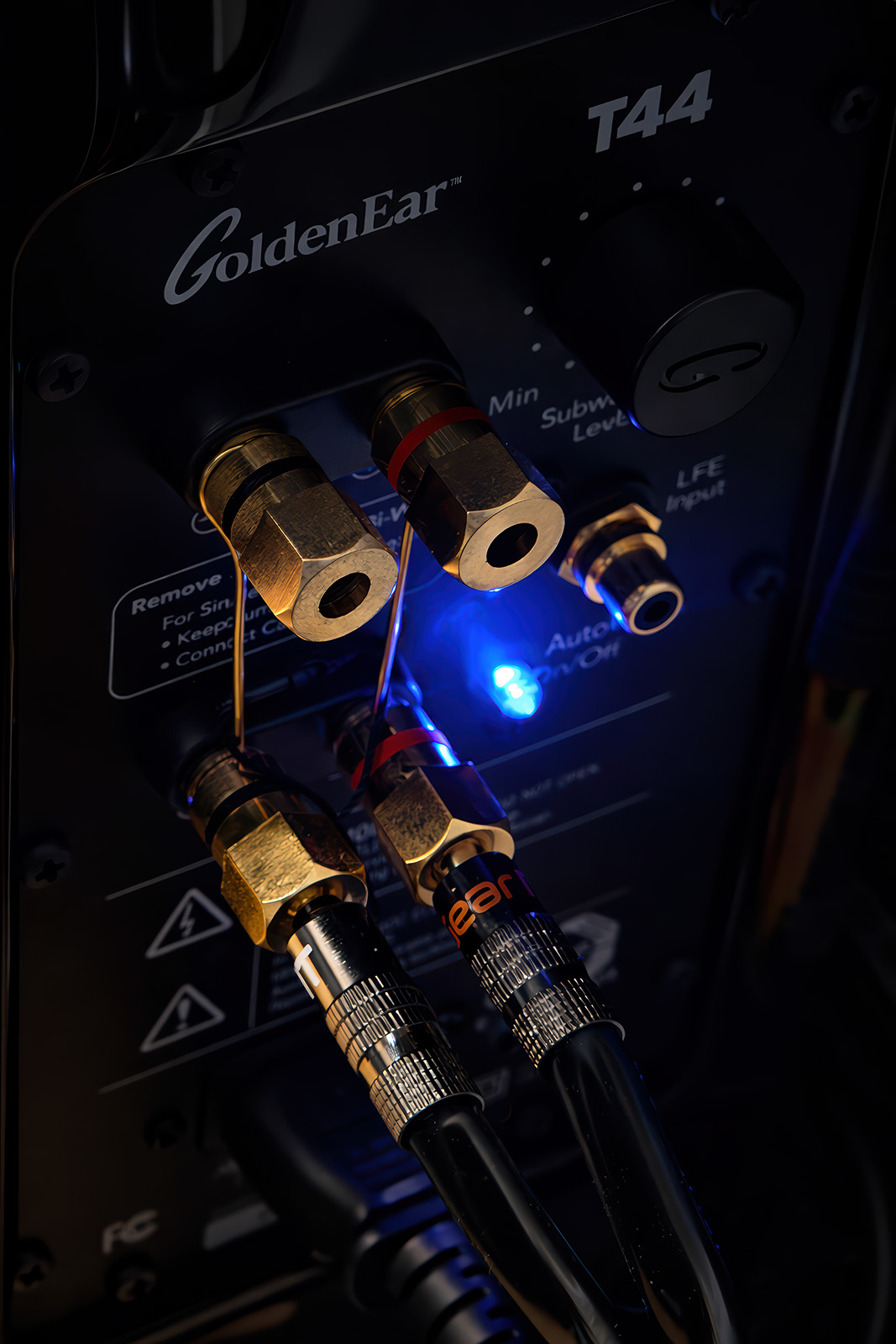
One reality of the active bass section is the need to run an AC power cord to each speaker, in addition to the speaker cables. You trade the extra cords for reduced strain on your main amplifier, deeper low-frequency output from a slim cabinet, and the adjustability we just discussed.
LFE input and surround use
When used in a home theater context, the T44 includes a line-level LFE input intended for an AVR or processor’s subwoofer output. The LFE connection supplements the speaker-wire connection; it does not replace it.
Set up correctly, the T44 works as a full-bandwidth main speaker for music, then accepts a discrete LFE feed for movies, giving you separate control of effects levels. GoldenEar’s manual describes a typical setup: fronts set to Large, subwoofer set to Yes, .1-channel content routed to the T44 via LFE, and no bass-doubling modes engaged.
The Anthem MRX SLM
The T44 towers are 4-ohm speakers which will typically draw more current from an amp than an 8-ohm load. But the last thing on my mind during the review period was the amp. And I say that having run the speakers with a 250 Wpc amp before switching to the 50 Wpc Anthem. Nothing was lost in the switch. It also happens to be a tidy brand-family pairing under current ownership.
ARC, and the ARC Genesis software for PC, is a major feature of the MRX SLM. The included calibrated mic is accurate and the software offers a granular view, and tools, for applying room correction.
Digging deeper
I did plenty of listening with the T44s running as a pure 2-channel system. I suspect most audiophiles would be thrilled by what they hear. Pair these with any decent 2-channel amp that supports 4 ohm loads and you’re in business. The vast majority of music genres are fully covered by the frequency response of the speakers alone. But not all!
The T44 specs say they play down to 32 Hz, and the measurements taken for ARC (using the supplied microphone) show that claim holds up in real life. That’s deeper than many towers dig, especially this size. But it is not “subwoofer” deep.
So I added a subwoofer to the mix. What sub? It’s a dual-opposed 12″ prototype that never got released and is able to reach 20 Hz and below (16 Hz, according to ARC’s measurements). I used a (standard) 80 Hz crossover. For the 2.1 implementation, I tapped ARC room correction to get the levels and timing right, and ensure the sub integrates properly (i.e. transparently).
After placement and toe-in (to get the basic geometry right), I used the Level controls on the speakers to land on a tonal balance that’s balanced and satisfying at the modest levels I typically listen at. Because one speaker is near a corner and the other is not, measurements showed a huge discrepancy in bass response. Consequently, I cut the bass on the left (corner) by three notches, and boosted the right speaker to about 3 notches (versus the 12 o’clock default). That brought the measured response of the speakers much closer, without applying any correction.
After that I ran ARC, which helped smooth out the remaining low-frequency peaks and dips and tightened the sub’s integration at the main listening position (aka the sweet spot). It relies on microphone measurements and applies algorithmic correction to the in-room response. The graphs looked good and the sound sparkled, so I figure it did its job well.
The speaker’s own bass adjustment gets you close. ARC Genesis adds the finishing touch.
Listening notes
The proof of performance is not in any one listening session or how the T44s handle any one album. It’s in the totality of the listening experience over the long term.
My source for music is a PC laptop running Amazon Music and Apple Music. For movies, I rely on an Xbox Series X and Apple TV VOD, although I do own some UHD Blu-rays as well.
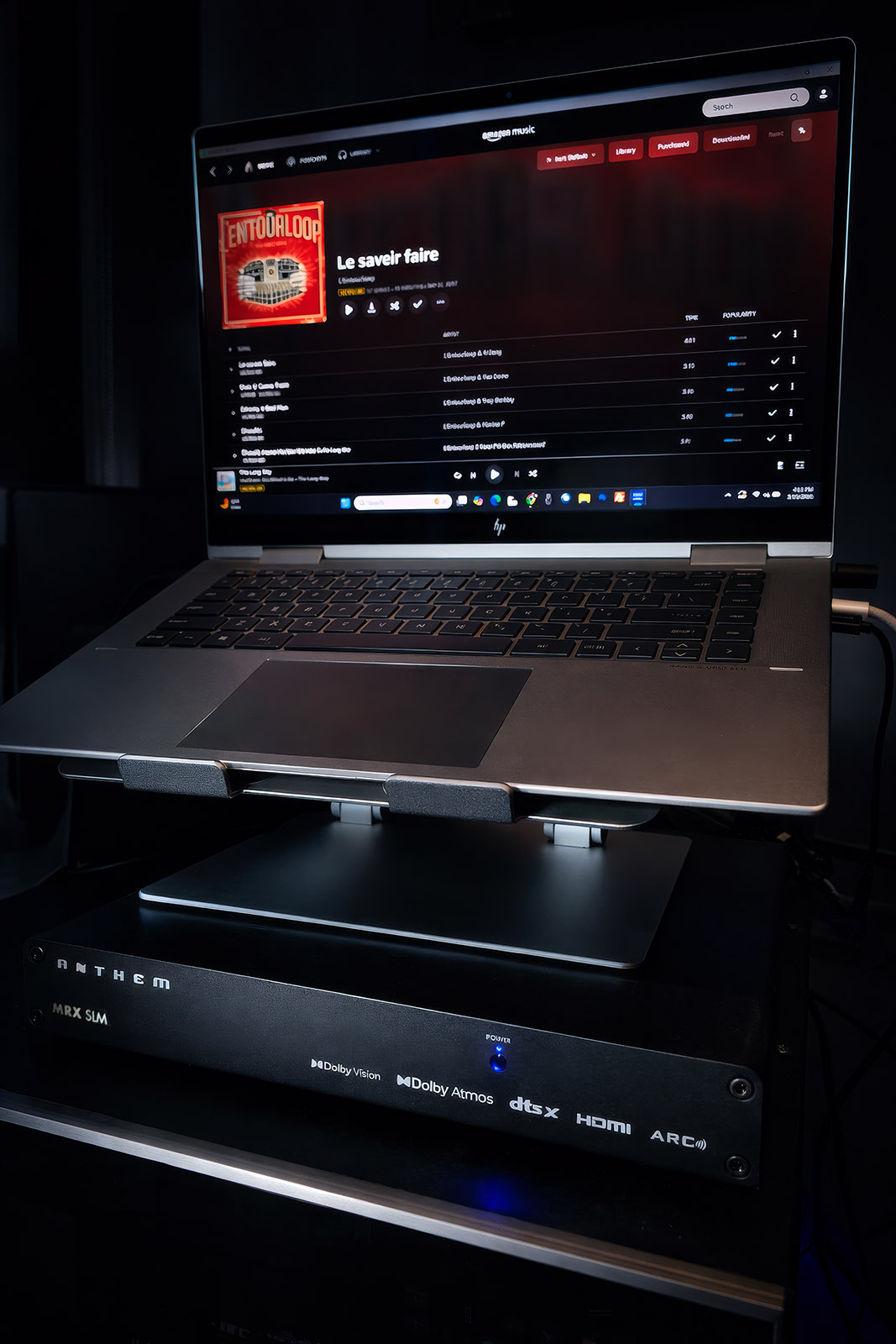
As it goes with any great-sounding speaker system, I was compelled to go through all my favorite albums, old and new. That means Bassnectar, Beastie Boys, Beatles, Brian Eno, The Cure, Kraftwerk, Laurie Anderson, L’entourloop, Nas, New Order, Renegade Soundwave, Riff Raff, Skinny Puppy, The San Francisco Symphony, Sly & Robbie, Sounds from the Ground, The Orb, Thievery Corp., Tripp St. (the list goes on and on and on). Only a few albums really needed the subwoofer to express their full potential, and with or without a sub, I’d rank the T44s quite highly for bass lovers.
I see no real purpose in hyper-analyzing any of these listening sessions. What matters is the perception of faithful playback. Most music is fully covered by their native frequency response. It’s near full-range sound, with excellent tonal balance, a lucid 3D soundstage that, if you close your eyes, is fully transportive and not boxed in by the room. Details that trigger the curiosity: “What can I hear in this album I am so familiar with that I may not have noticed before?”
Overall, the T44 delivers; at lower listening levels, the totality of the audio illusion remains intact. Having a party? Turn it up; the speakers keep their composure. GoldenEar recommends 20 to 400 watts per channel to power them. I can’t fully utilize what the T44s offer, but for anyone who wants more output for a new-generation GoldenEar, there’s the T66.
With movies, I’m not trying to replicate the precision and envelopment of a proper dedicated home theater. But I do believe that in a living room context, when compared to spending the same money spread out over five different speakers (L/R/C/LS/RS), spending on a single pair of speakers will do the most to make movies sound better. Granted, there’s no center channel, but unless you have an acoustically transparent screen (I do not) the center channel will be in the wrong place for good sound. Better to rely on the “phantom center” effect, which in the world of 2-channel audio is simply known as “good imaging.”
Is it for you?
In a world where robust bass capability usually means either large cabinets combined with big amps, or adding separate subwoofer(s), the T44 offers an option that works exceptionally well in my small apartment application.
GoldenEar’s appeal has long been a blend of performance, finish, and form factor: modern and premium, but still tied to realistic budgets. But the semi-active concept is a commitment to a different approach than your classic passive speaker setup. If you prefer an all-passive tower on principle, the T44 won’t appeal. But if the benefits of extra power on tap and fine per-speaker control over bass output that works even without room correction or external EQ are appealing, the T44s offer advantages passive speakers cannot match.
Closing thoughts
The GoldenEar T44 is a bit like a modern GoldenEar “greatest hits” package. It’s got flagship looks and sound, but sized for real rooms. Paired with the Anthem MRX SLM with or without a subwoofer, the system delivered everything I’ve ever asked for from a system at this price. If I decide to replace my Triton Sevens someday, the T44s will be on the shortlist